Missouri has no single statewide HOA fence rule. Your fence is controlled by three layers: your neighborhood’s recorded covenants, your city’s code, and the property lines on your lot. The HOA can say no even when the city says yes, and courts in Missouri have backed associations that enforce clear fence restrictions. This guide walks through how those layers fit together, what to look for in your documents, and what St. Peters requires, since homeowners there ask us about it often.
TL;DR
- An HOA in Missouri can restrict fences when its governing documents clearly say so, and courts enforce unambiguous terms as written.
- City rules and HOA rules stack. You have to satisfy both, and the stricter one wins in practice.
- In St. Peters, residential fences top out at six feet, the finished side faces the street, and front-yard placement is limited by the building line.
- Get written HOA approval before you sign a contract or dig a post hole. An HOA that overlooked a violation before may still enforce later.
- Check your plat, survey and easements first, because fences on utility easements can be removed at your expense.
Table of Contents
- Who decides: the HOA, the city, or both
- How Missouri courts treat HOA fence restrictions
- Why HOAs restrict fences in the first place
- What to check in your HOA documents before you apply
- St. Peters fence rules: height, setbacks and permits
- Our perspective: approval first, then design
- What to do if your HOA denies your fence request
- Picking a fence that gets approved the first time
- Working with Precision Outdoor Solutions
- FAQ
- Sources
Who decides: the HOA, the city, or both
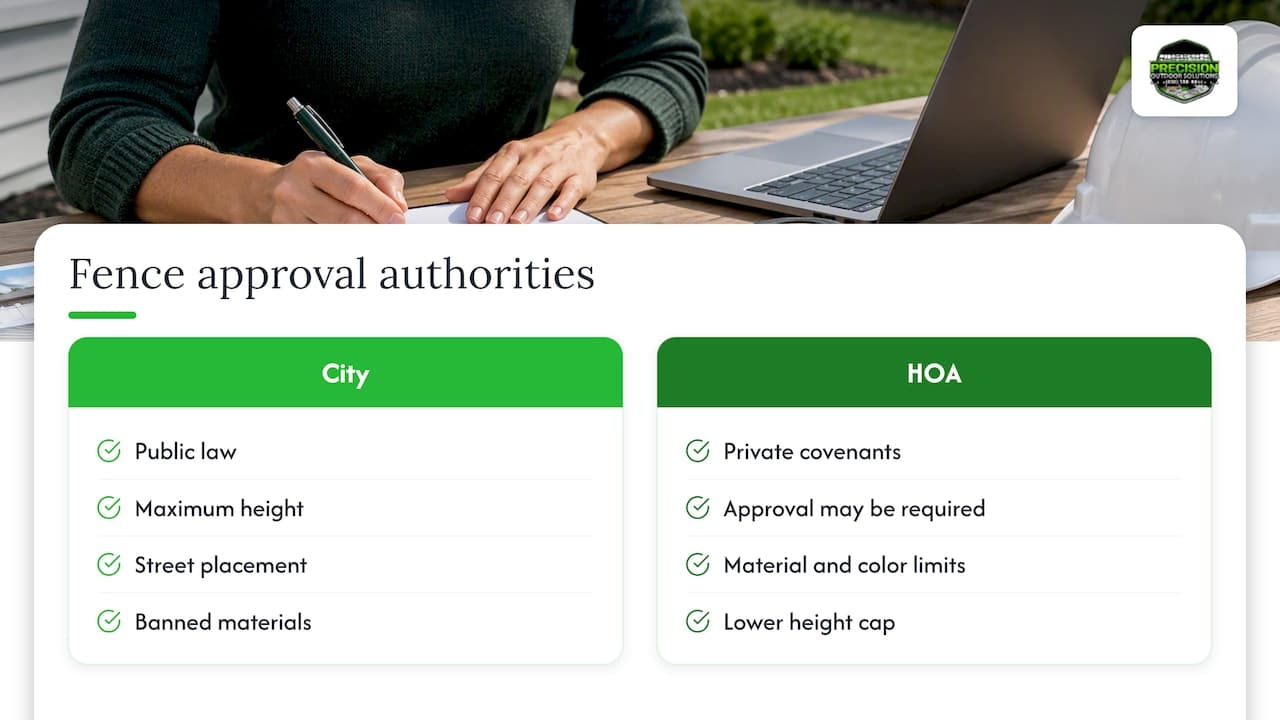
Think of fence approval as two separate gates.
The city gate is public law. It sets maximum heights, placement relative to the street, banned materials, and whether you need a permit. Every homeowner inside city limits faces it, HOA or not.
The HOA gate is private contract. When you bought your home, you took it subject to recorded covenants, often called a declaration, indenture or restrictions. Those documents can be stricter than the city. They can require approval for any fence, limit materials and colors, set a lower height cap, or ban certain fence types outright.
Passing one gate does not get you through the other. A fence that is legal under the city code can still violate your declaration, and the reverse is also true.
How Missouri courts treat HOA fence restrictions
Missouri courts treat covenants as contracts. In July 2025, the Missouri Court of Appeals decided Bellemeade Homeowners Association v. Tyler Taylor and upheld the association’s right to enforce fencing restrictions in its Declaration of Trust and Restrictions against a homeowner. The court looked at what the document said, and clear language was enforced as written.
That case came out of St. Peters. Local coverage reported that the Bellemeade association sued two homeowners over fences enclosing side yards. The takeaway for you: an HOA that believes you broke a fence rule may go to court, and that gets expensive.
A few other principles are worth knowing:
- Past leniency may not protect you. The Court of Appeals held in the Bellemeade case that an HOA’s earlier decision not to enforce a restriction is not a waiver of its right to enforce it later, as long as the governing documents contain an anti-waiver provision. “Your neighbor has one” is not a safe argument.
This is general information, not legal advice. If you are in a dispute, a Missouri attorney who handles real estate or HOA matters can read your actual documents.
Why HOAs restrict fences in the first place
The stated reasons are usually practical. One Missouri association’s fence standards, for example, aim to minimize the impact on neighbors and maintain and enhance property values.
In plain terms, boards want a consistent look along streets, open sight lines at corners, and no fence that blocks a neighbor’s view or drainage. That is why many associations care most about front and side yards, corner lots and anything visible from the street. Knowing the reason behind a rule helps you design a fence that gets approved.
What to check in your HOA documents before you apply
Pull these before you talk to any fence contractor:
- The declaration (CC&Rs, indenture or trust). Search for “fence,” “enclosure,” “barrier” and “structure.” Fence rules sometimes hide in general clauses about outbuildings or exterior changes.
- Architectural or design guidelines. These often hold the details: approved materials, colors, picket spacing, gate styles and height limits.
- The application form and process. Find out who reviews it, what drawings are needed, and how long the committee has to respond.
- Amendments. Rules change. Make sure you have the current version, not the one in your closing packet from years ago.
- The recorded plat. It shows easements and building lines that affect where a fence can sit.
If you cannot find the documents, ask your HOA or management company for the declaration, guidelines and application. You can also search recorded covenants, plats and amendments through the St. Charles County Recorder of Deeds, as one local ARC guide recommends for subdivisions in the county.
Questions to answer from the documents
| Question | Why it matters |
|---|---|
| Is approval required for any fence? | Most associations require it before construction starts |
| What is the maximum height? | May be lower than the city limit |
| Which materials and colors are allowed? | Wood, aluminum, vinyl and chain link are treated differently |
| Are front-yard or side-yard fences allowed? | Often the biggest restriction |
| How are corner lots handled? | Sight lines are a common concern |
| What happens if I build without approval? | Fines, removal orders, and possible attorney fees |
| Is there a deadline for the committee to respond? | Some documents treat silence as approval, others do not |
St. Peters fence rules: height, setbacks and permits
Because fence setback questions in St. Peters come up so often, here is what the city’s rules say. They come from City Code Section 405.360, in the Zoning and Subdivision Regulations. Always confirm against the current code before you build.
Height. Residential fences may not exceed six feet unless the specific district regulations say otherwise.
Front yard placement. Generally, fences cannot extend into the front yard beyond the front building line of the house. The city uses building lines and property lines to set these boundaries.
Corner lots. On a corner lot, a fence cannot extend beyond the front building line parallel to the house front. It may extend 10 feet beyond other front building lines, as long as it does not block sight distance.
Finished side. When a fence is next to a public street, the improved or finished side must face the street.
Materials. The city code prohibits barbed wire, hardware cloth and similar materials on residential fences.
Permits. St. Peters requires no permit for fence installation except where Section 405.360 requires one. The city’s guide notes that fences in commercial, industrial and multiple-family districts must submit an application, so a single-family homeowner is usually outside that requirement. A call is still the safest check.
Utility easements. If a fence sits on a dedicated utility easement, the city is not responsible for replacing it if it must be removed for maintenance.
Confirming the rules for your lot
General rules only go so far, because your lot’s building lines and easements are specific to your plat. Start with your property survey, then call the St. Peters City Planning Department at (636) 477-6600, the number the city gives for these questions. Other cities in St. Charles County, such as O’Fallon, Wentzville and Troy, have their own codes, so do not assume St. Peters numbers apply to them.
For a broader look at distances and heights, see our guide to fence setback rules and property line distances and our privacy fence height checklist.
If you also have a pool, separate safety requirements come into play. This pool safety fence guide covers what families should think about when enclosing one.
Our perspective: approval first, then design
We build fences across Wentzville and St. Charles County, and the projects that go smoothest share one habit. The homeowner gets the HOA’s written approval before the work is scheduled.
Here is what we have learned over more than 25 years in this work:
- Read the documents before choosing a style. It is easier to pick a fence that fits the rules than to redesign one after a denial.
- Plan the property lines early. A survey, easements and building lines decide where a fence can go. Drainage matters too, because a fence that blocks a swale can push water toward a neighbor’s yard or your own patio.
- Keep the paperwork. Save the approval letter, the drawings you submitted and the materials list. If a question comes up later, you have a record.
- Talk about timelines honestly. HOA review takes time. We would rather tell you that up front than promise a start date the committee has not approved.
A fence that is built to last, looks right on the street and meets every rule is the goal. That is what careful planning gets you.
, Precision Outdoor Solutions
What to do if your HOA denies your fence request
A denial is not always the end. Work through these steps in order:
- Get the denial in writing, with the specific provision it relies on. A denial with no stated basis is hard to evaluate.
- Compare it to the documents. Does the declaration actually say what the board claims? Missouri courts read restrictive terms strictly, but they enforce clear ones.
- Check for rule changes. A board generally cannot use a later rule to override what the declaration expressly permits. Review whether a new guideline conflicts with your recorded covenants.
- Revise and resubmit. Lower the height, change the material, or pull the fence back from the street. Many denials turn on one detail.
- Ask about a variance or appeal. Many associations have a process for this.
- Escalate carefully. Mediation is an option before litigation, and an attorney can tell you whether your case is worth pursuing, given that the HOA’s documents may let it recover legal fees.
One caution: do not build and hope for the best. Because the Bellemeade ruling confirmed that earlier nonenforcement may not stop an association from enforcing later, an unapproved fence can become a removal order and a legal bill.
Picking a fence that gets approved the first time
Boards approve what is easy to evaluate. A clean submittal usually includes:
- A plot plan or survey with the fence line marked and distances from property lines.
- Height, material, color and finish, with a photo or spec sheet.
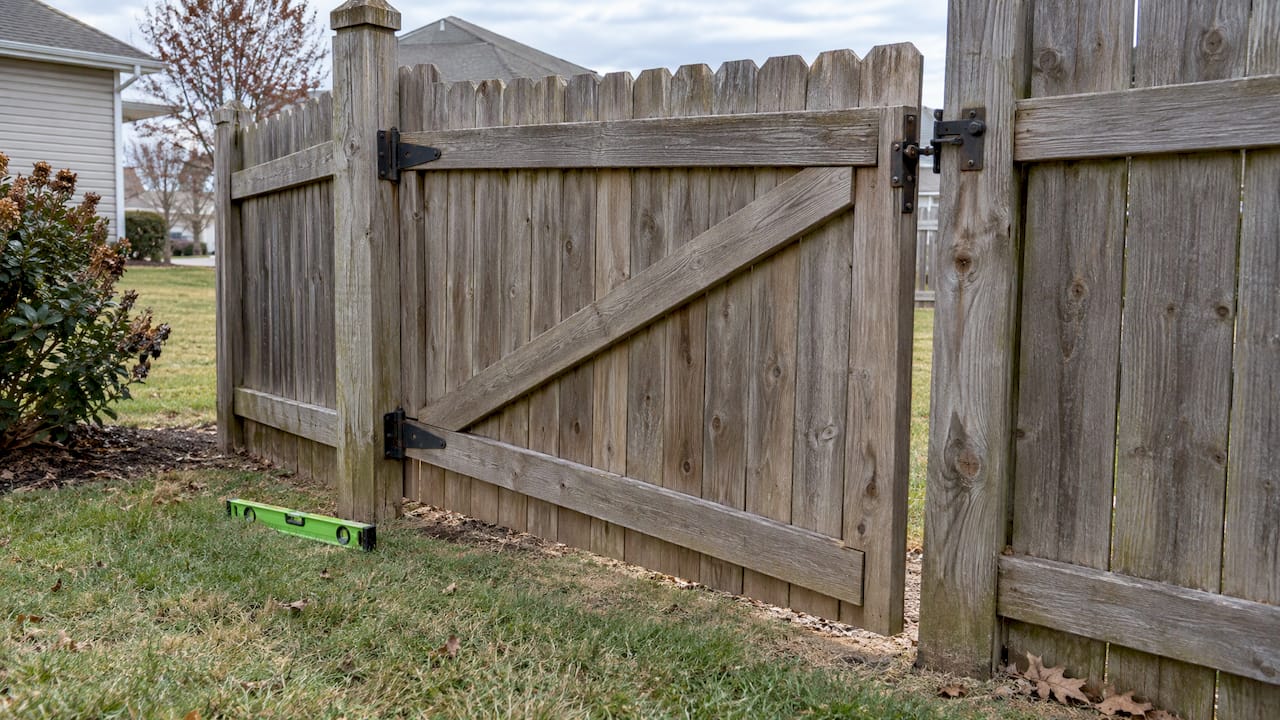
- Gate locations and swing direction.
- Which side faces out, since the finished side should face the street or neighbors.
Style matters too. Our guide to fence styles that boost curb appeal can help you choose something both attractive and likely to meet a board’s standards.
Working with Precision Outdoor Solutions
If you are planning a fence in Wentzville, St. Peters, O’Fallon, Troy or elsewhere in St. Charles County, Precision Outdoor Solutions can help you plan a fence around your HOA’s rules and your city’s code, then install it with attention to durability and clean job sites. We offer a site consultation, design planning and material selection, and we keep you updated on timelines throughout.

See our fence installation services or visit Precision Outdoor Solutions to ask for a free estimate. Bring your HOA guidelines, and we will plan around them.
FAQ
Can an HOA stop you from putting up a fence in Missouri?
Yes, if the governing documents clearly restrict or require approval for fences. Missouri courts enforce unambiguous covenants as written, as the Court of Appeals did in the 2025 Bellemeade case. Vague or conflicting language is read more strictly in the homeowner’s favor.
What is the fence law in Missouri?
There is no single statewide residential fence code for suburban lots. Cities set their own height, placement and permit rules, and HOAs add private restrictions on top. Check your city code and your declaration.
Do I need a permit for a fence in St. Peters?
St. Peters requires no permit for fence installation except where Section 405.360 calls for one, which the city’s guide ties to commercial, industrial and multiple-family districts. Call City Planning at (636) 477-6600 to confirm for your lot.
How tall can a fence be in St. Peters?
Residential fences generally cannot exceed six feet, unless district regulations say otherwise. Your HOA may set a lower limit, so the lower number is the one you follow.
Can my HOA enforce a fence rule it has ignored before?
Possibly. In the Bellemeade case, the Court of Appeals held that past nonenforcement did not waive later enforcement because the governing documents had an anti-waiver provision. Check whether your declaration has one, and ask an attorney if you are in a dispute.
Sources
- Bellemeade Homeowners Association v. Tyler Taylor, Missouri Court of Appeals (2025)
- St. Peters HOA spends thousands suing homeowners for their fences (FOX 2)
- Tremont Manor Homeowners’ Association fence standards
- City of St. Peters fence requirements guide
- Pool safety fence guide for families
Recommended
- Which Fence Styles Actually Boost Curb Appeal?
- Fence Setback Rules: Height Limits And Property Line Distances
- Wood vs Vinyl vs Chain Link Fence: Which Fits Your Yard
- Avoid Permit Delays: Privacy Fence Height Checklist For Homeowners
This article was prepared with AI assistance for general information. For recommendations specific to your property, contact Precision Outdoor Solutions. Call or text us at (636) 358-8644.