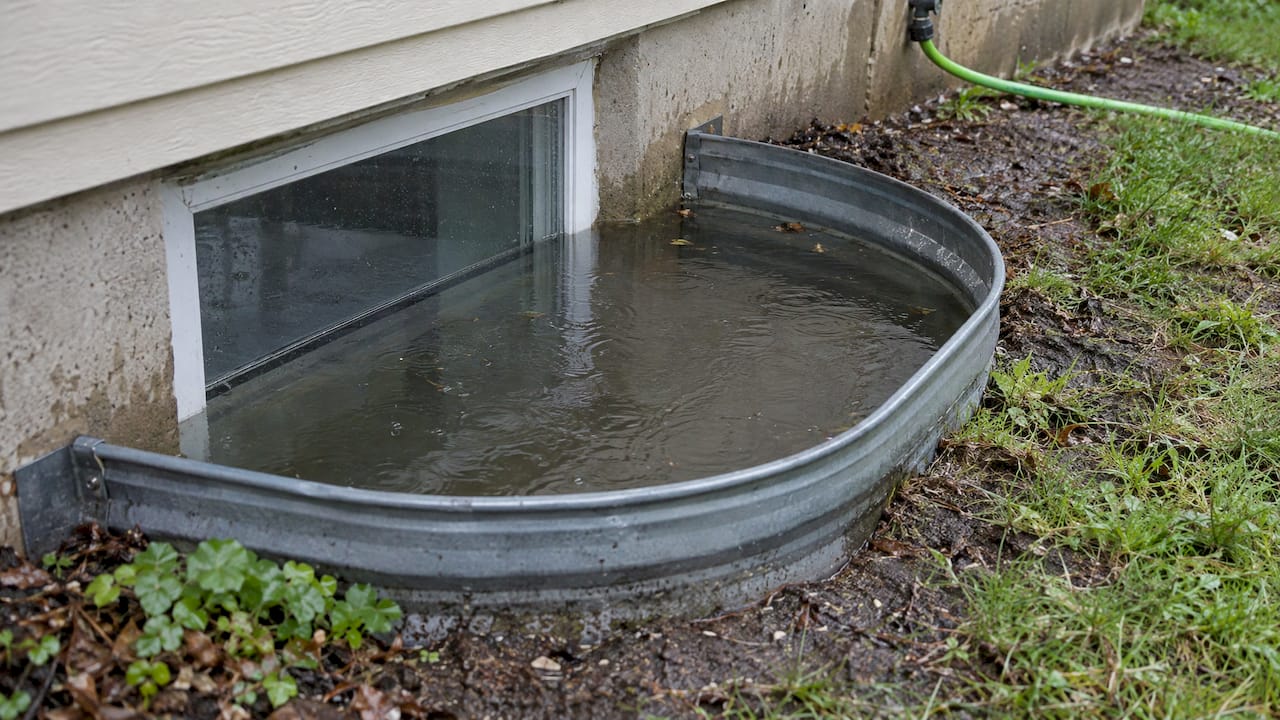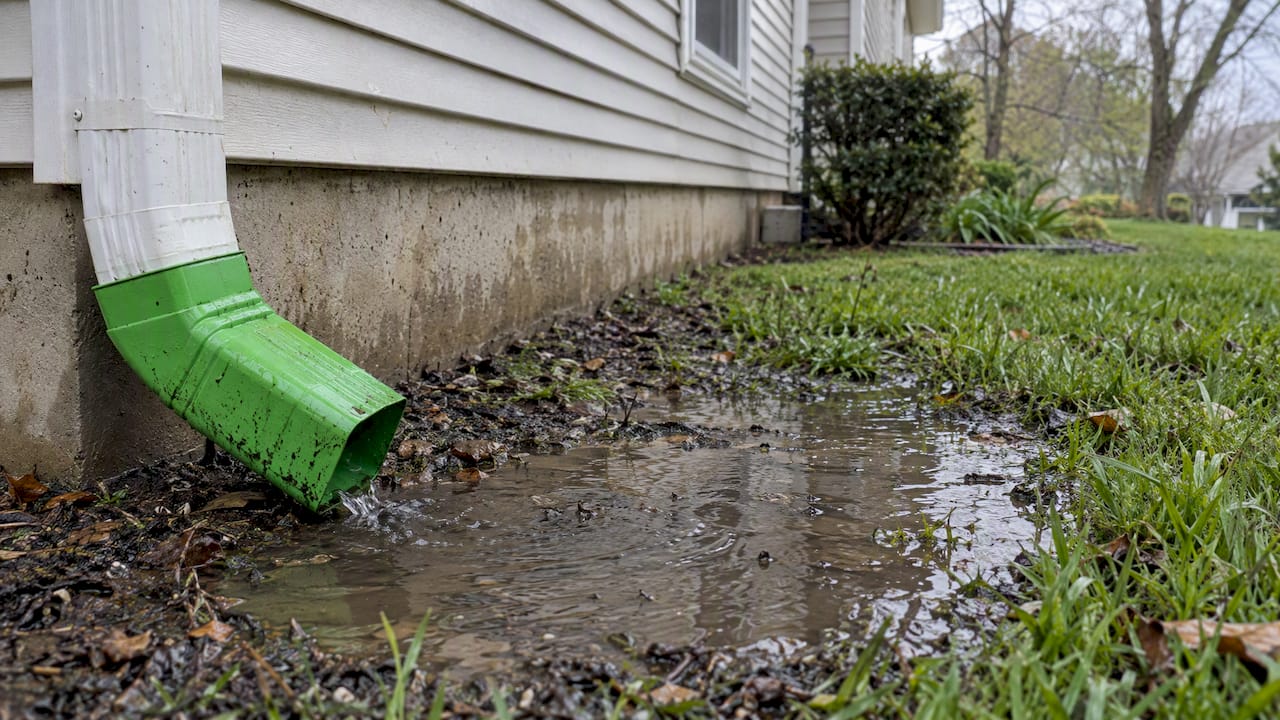
The most reliable way to control backyard erosion in Missouri is to keep soil covered, slow the water that crosses it, and send runoff somewhere safe. In most yards that means plants or mulch on bare ground, better grading, and a drain, swale, riprap or retaining wall where water concentrates. Start by watching where water goes in a heavy rain, because the fix depends on the cause.
This guide walks through how to read your yard, which fixes match which problems, what they cost, and when to bring in a contractor. At Precision Outdoor Solutions, we work on these problems in Wentzville and across St. Charles County, so we’ve included what we see on local properties.
TL;DR
- Erosion starts when rain runs off roofs, pavement, bare soil and slopes faster than the ground can absorb it. Map that runoff during a storm before you buy anything.
- Keep soil covered. Dense groundcovers, native plantings, mulch or erosion blankets stop soil particles from detaching in the first place.
- Grade so water moves away from the house without creating steep slopes or low spots. Concentrated flow needs a swale, drain or riprap.
- Walls taller than a few feet, steep banks and heavy flow call for engineered design, drainage behind the wall and a permit check.
- Call 811 before any digging. Large disturbances can trigger state permit rules.
Table of Contents
- What causes erosion in a Missouri backyard
- How to assess how bad it is
- Cover the soil first: plants, mulch and blankets
- Fix the water path: grading and drainage
- When riprap makes sense
- When a retaining wall is the right answer
- What erosion control costs
- Installing and maintaining erosion controls
- Permits, utilities and local help
- Our perspective: fix the water, then build
- Let us look at your yard
- FAQ
- Sources
What causes erosion in a Missouri backyard
MU Extension describes stormwater as rain or snowmelt that doesn’t soak in and instead runs off rooftops, paved areas, bare soil and sloped lawns, carrying soil and pollutants with it. Most backyard erosion follows one of a few patterns:
- Roof and downspout water dumped at one point, which cuts a channel.
- Bare or thin turf on a slope, where raindrops loosen soil and it washes downhill.
- Concentrated flow from a neighbor’s yard, a driveway or a patio edge.
- Low spots where water ponds, soaks the soil and later overflows.
- Recent construction, where topsoil was stripped or compacted and plants haven’t re-established.
Soil type matters too. Missouri’s AgSite tool notes that soil texture affects water retention, erosion potential and drainage. Sandy soils can lose nutrients and blow away if left uncovered, while clay soils drain poorly. Poor drainage in clay means water sits on the surface longer and runs off in sheets during big storms.
How to assess how bad it is
You don’t need instruments for a first assessment. The Missouri Botanical Garden’s rainscaping guide suggests mapping your property, watching water flow during heavy rain, and noting steep slopes, ponding in low areas, recent construction and utility lines.
Try this during the next hard rain, with a rain jacket and your phone:
- Sketch the yard and mark the house, downspouts, patio, fence and any slope.
- Draw arrows where water moves. Note where it speeds up, where it pools and where it leaves your property.
- Photograph bare patches, gullies, exposed roots and soil fans (the silty deposits at the bottom of a slope).
- Return after the rain and mark where soil moved.
- Check the foundation, fence posts and patio edges for undermining, settling or soil buildup.
We’d call it a minor problem when you see thin turf and a little silt. It’s moderate when you see a defined rill or gully. Treat it as serious when water reaches the foundation, a retaining wall shifts, or a bank is giving way. Our guide to signs you need a drainage solution in Wentzville lists more of the warning signs.
Cover the soil first: plants, mulch and blankets
Bare soil is the easiest to fix and the most common cause. MU Extension’s guidance on controlling runoff says effective stabilization means keeping soil covered with vegetation, mulch or geotextile blankets, since that prevents particles from detaching, the first phase of the erosion cycle.
Groundcovers and native plants
Groundcovers are low plants that spread quickly into dense cover. MU Extension publishes a list of selected ground covers for Missouri that are reliably cold hardy across the state, so start there rather than guessing at a nursery. Match the plant to the site: sun or shade, wet or dry, and how steep the ground is.
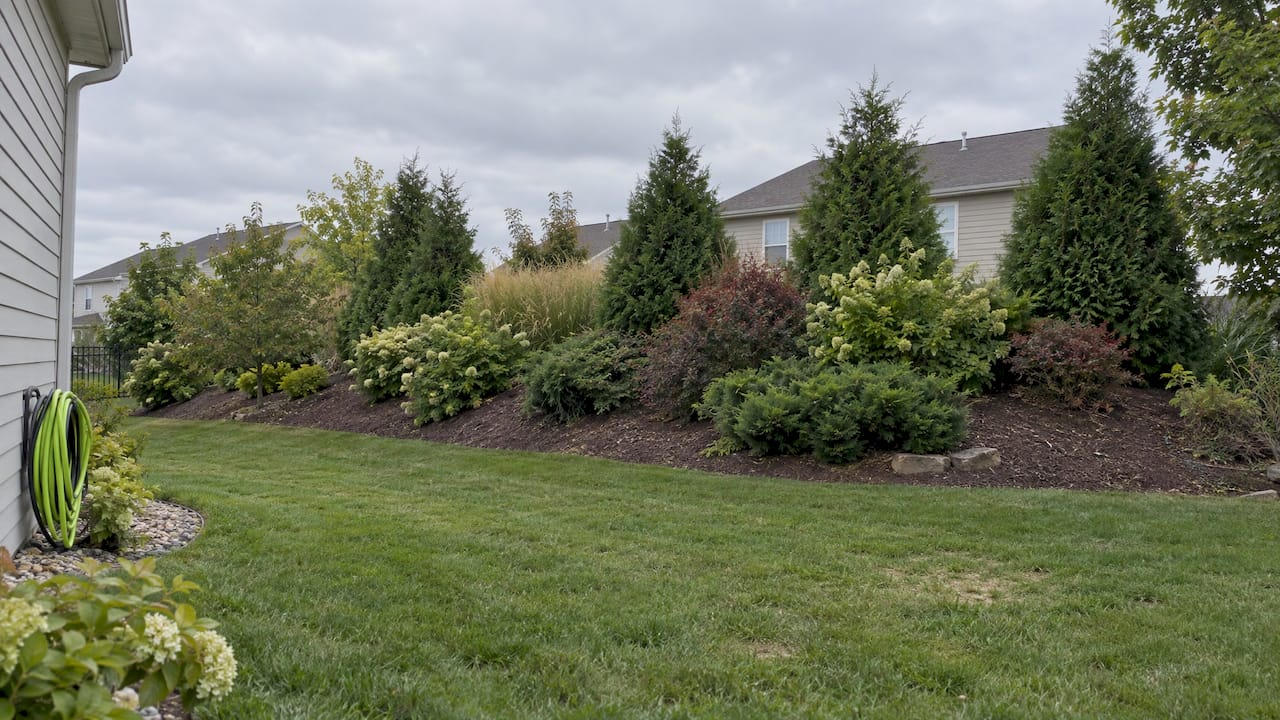
Native plants are a strong choice for slopes and drainage areas. Deep, fibrous roots hold soil and open it up for water. Missouri Botanical Garden materials note that rain gardens planted with natives can need less maintenance than lawn, and the roots help water percolate. We cover good picks in our guide to native plants for Missouri yards, and our article on slope erosion control explains why plants come first and drainage right after.
Mulch, seed and blankets
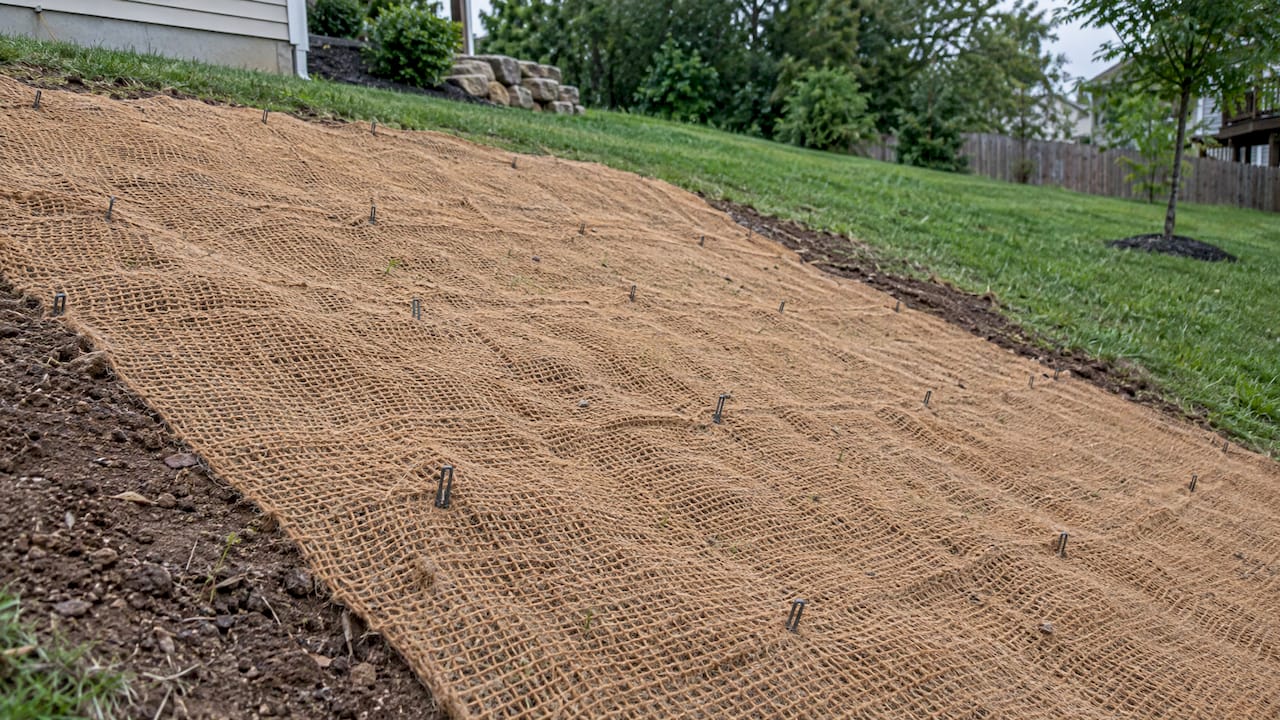
Plants take a season to establish, and new plantings are the most vulnerable. Cover new beds with a layer of mulch, and on steeper banks pin down a biodegradable erosion blanket over seed. Straw or coconut blankets hold seed and soil in place while roots grow in. Inspect after storms and re-seed any thin spots.
Test the soil before you plant. MU Extension recommends soil testing so nutrient deficiencies and pH can be corrected, then applying recommended amounts of fertilizer and amendments. Healthy soil grows denser cover, and denser cover holds better.
Fix the water path: grading and drainage
Plants alone won’t hold if a stream of water keeps hitting them. The goal is to get water off the slope and away from the house gently.
MU Extension advises providing good surface drainage without creating steep slopes, depressed areas or large level areas, and says the average lot should be raised at least 6 inches at the center or around buildings. In practice, soil beside the foundation should fall away from the house. We explain the numbers homeowners should ask about in our grading guide.
Common tools, from simplest to most involved:
| Problem | Typical fix | Notes |
|---|---|---|
| Downspout dumping on the lawn | Buried extension pipe or splash-free outlet to a stable area | Keep the outlet away from the foundation and neighbors |
| Water sheeting across a slope | Shallow swale, planted or lined | Slows and redirects flow to a safe exit |
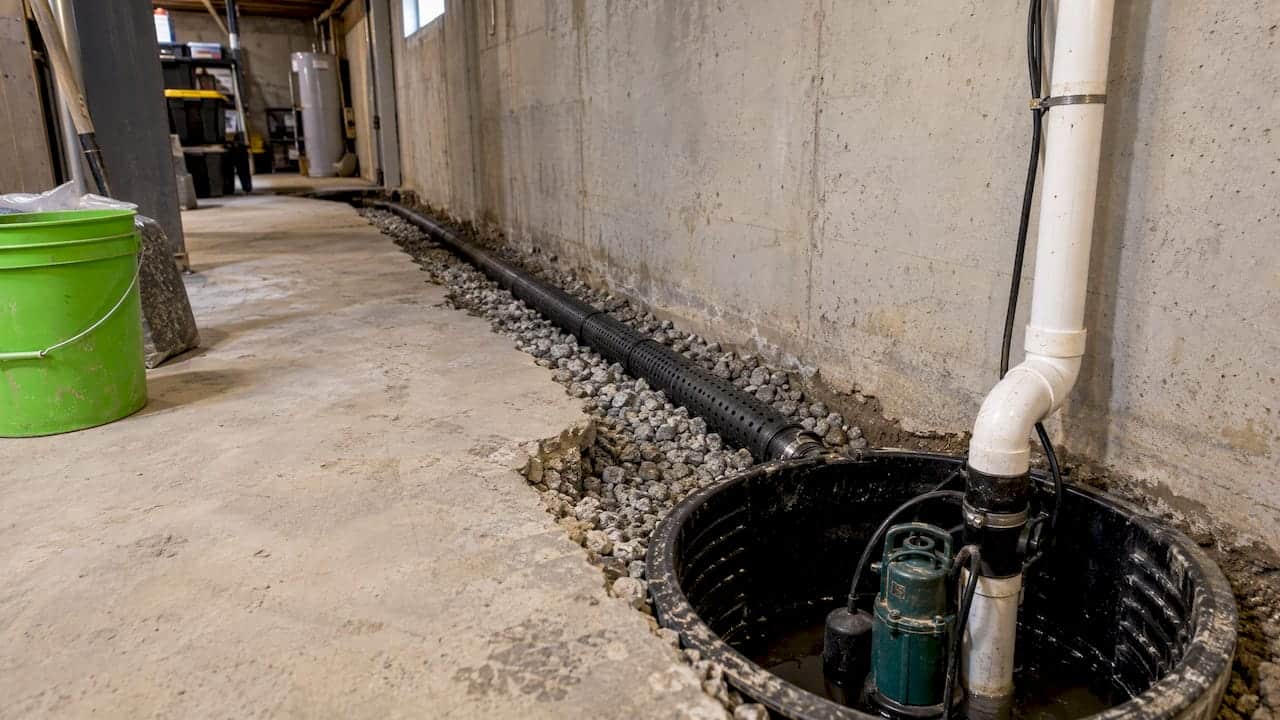
| Soggy low area | Regrading, French drain or rain garden | Needs a place for the water to go |
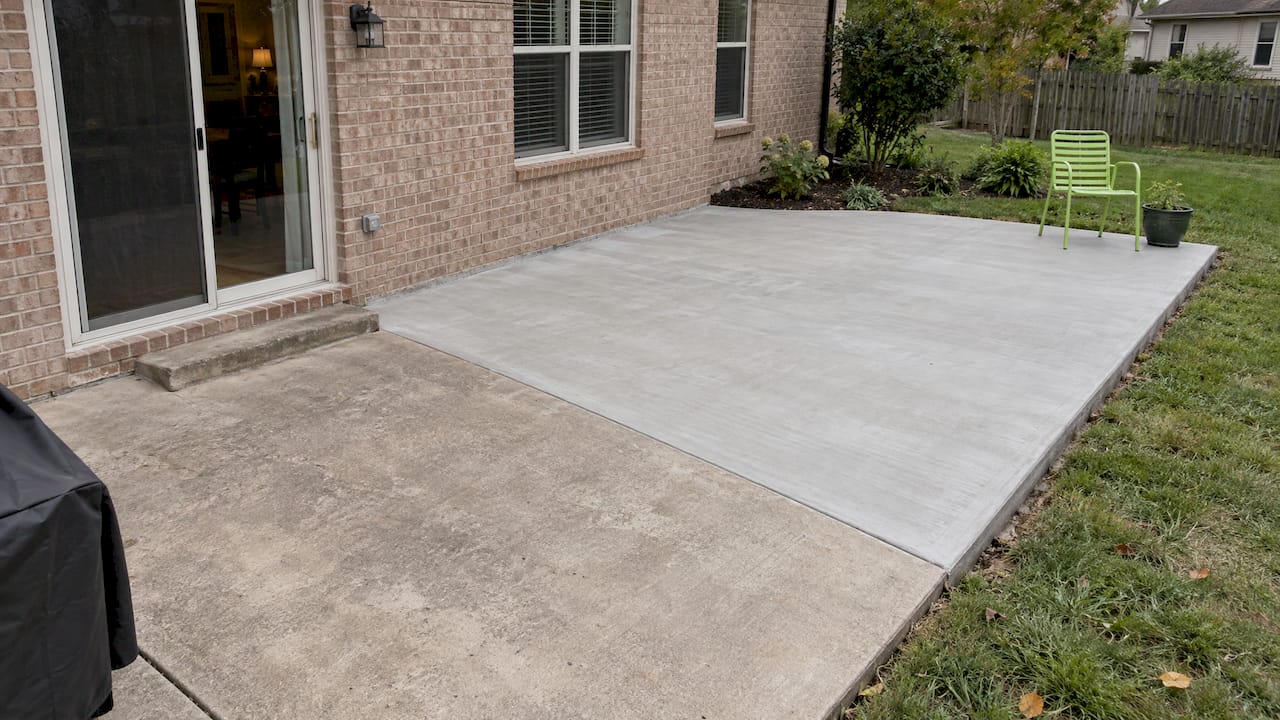
| Water pooling beside a patio | Slope the surface away, add a drain | See our patio drainage design guide |
| Concentrated flow cutting a gully | Riprap, check structures or a lined channel | Needs a stable outlet |
| Steep bank that won’t hold plants | Terraces or a retaining wall | Needs drainage and often design |
In the Wentzville area, a lot of the trouble comes from clay soil and new-construction grading that sends water across several lots. Fixing only the spot where you see the damage often moves the problem a few feet. That’s why we begin with the whole water path. Our landscape design process deals with drainage before any plants or hardscape.
When riprap makes sense
Riprap is angular stone placed where water would otherwise scour the soil: at pipe outlets, along channel banks, below a downspout discharge. The EPA says it protects soil in areas of high or concentrated flows and is useful where other practices have exceeded their stabilization capacity.
A few details decide whether it lasts, according to the same EPA fact sheet:
- Use a well-graded mix of angular, durable stone sized for the flow, not rounded river rock.
- Place filter fabric, geotextile or gravel beneath it so the soil underneath can’t migrate out.
- Slopes steeper than 2:1 can cause riprap to slide, so look at other materials there.
That last point matters on steep Missouri bluffs and creek banks. Loose stone on a steep bank is a temporary patch, not a fix.
When a retaining wall is the right answer
If a slope is too steep to stabilize with plants and there isn’t room to regrade it to a gentler bank, a wall can be the right tool. The Building America Solution Center recommends considering terracing or retaining walls for steep slopes, especially where heavy rain might destabilize exposed terrain or something valuable needs protection.
Before you commit, think through:
- Drainage behind the wall. Snohomish County, Washington, warns in its homeowner guide that water buildup behind a wall can cause failure. Gravel backfill and a perforated drain pipe with an outlet are part of the wall, not an extra. Our retaining wall drainage guide covers this in detail.
- The base. The same county guide advises removing at least a foot of organic-rich soil under the footing and replacing it with compacted crushed rock to reduce sagging.
- Height and load. That guide notes permits and engineered plans are required there for walls over 4 feet including buried height. Missouri rules vary by city and county, so ask your local building department. Walls that carry a driveway, a structure or a steep slope above them need professional design. The guide recommends a qualified landscape architect or civil or geotechnical engineer.
- Site conditions. The Texas DOT notes that wall choice and stability depend on site geometry, soil conditions and project-specific analysis.
Those last sources are from other states, so treat them as good engineering principles rather than Missouri code.
What erosion control costs
There’s no single price, because the method, the square footage and the access all change the number. Good public benchmarks are scarce for residential work, so use these as rough orientation only.
- The EPA lists riprap examples from $64 to $750 per cubic yard, depending on location, material and installation method.
- An archived EPA calculator shows how project duration, footage, inspections, sediment removal and repairs push the total up. For 400 linear feet over six months, it listed about $3,001 to $3,855 across compost berms, socks and silt fencing in 2006 dollars, so today’s costs run higher.
- Montana DOT’s 2025 schedule puts hydraulic wood mulch at $98 per 1,000 square feet, with blankets and geotextiles several times that. Those are highway contract rates from another state, but they show the pattern: covering soil with plants or mulch costs far less than armoring it with stone or walls.
The lowest-cost projects usually fix the cause, such as a downspout or a low spot, rather than the symptom. For a firm number, you need someone to walk the property. We offer a free estimate and explain what’s driving each line. Our piece on what landscape design costs in 2026 helps you plan the design portion.
Installing and maintaining erosion controls
A control that’s installed wrong or never checked can fail in the first storm. Boone County’s residential builder guide says erosion and sediment controls must be installed correctly and kept functional until the site is permanently stabilized. It recommends inspecting silt fences and fiber rolls weekly and after rain events above one-half inch, and fixing problems right away.
That is construction-site guidance, but the habit works in any yard:
- Walk the yard after every heavy rain for the first season.
- Clear debris from outlets, swales and drain grates.
- Re-seed or re-mulch bare spots quickly.
- Watch new plantings for dry spells, since young roots do the stabilizing.
- Check where a wall’s drain outlet discharges.
Our fall lawn plan for Missouri is useful for timing overseeding on thin slopes. If you’d rather not handle the upkeep, our lawn and landscape maintenance service covers it.
Permits, utilities and local help
Two rules are worth knowing before anyone picks up a shovel.
First, Missouri law requires you to notify Missouri 811 before any excavation, even digging in your own yard. Buried lines get marked free. Do this whether you hire a pro or not.
Second, the Missouri Department of Natural Resources requires land disturbance permits for construction disturbance of one or more acres, including smaller sites that are part of a larger common plan. A typical backyard fix is far below that, but a new subdivision lot or a big regrade might not be. Cities add their own rules: Jackson, for example, requires a stormwater permit for all new impervious surfaces. Check with your city or county building department before adding a patio, wall or major grading.
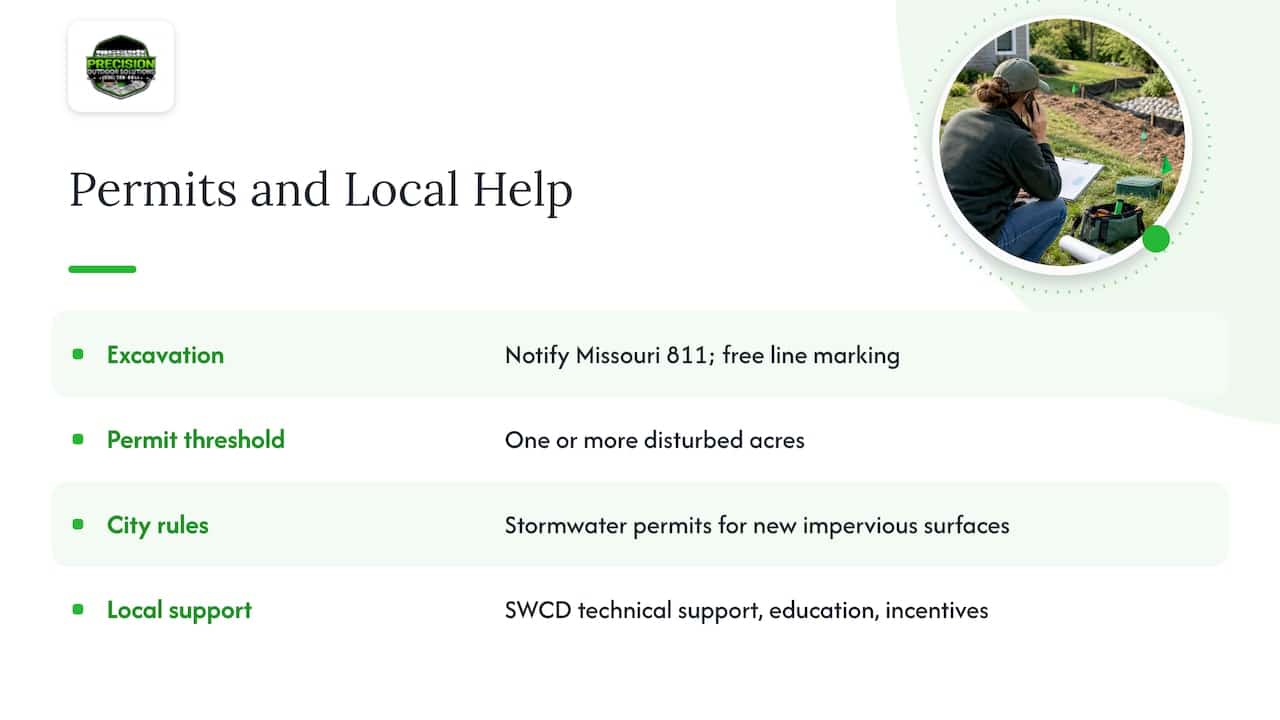
Help is also available locally. Missouri’s Soil and Water Conservation Districts give technical support, education and, in some cases, financial incentives to landowners putting erosion practices in place. If your property has a creek or large acreage, call your county district.
Our perspective: fix the water, then build
We’ve worked on outdoor spaces in Wentzville and St. Charles County for more than 25 years, and the pattern is consistent: most erosion calls are really water calls. The slope or the patio edge is where you see the damage. The cause is usually a downspout, a low spot or a grade that sends water the wrong way.
That’s why we start with a site consultation and walk the property with you, ideally while you can show us where water goes in the rain. We then plan drainage, grading and plantings together so each piece supports the others. A wall with no drainage behind it, or a bed of new plants on a channel of runoff, tends to fail for the same reason.
We build for durability: proper bases, clear timelines, a tidy job site and regular updates so you always know what’s next. Our goal is a yard that looks good and holds up after the third big storm, not just the first week.
Precision Outdoor Solutions
Let us look at your yard
If you’re seeing gullies, pooling or a bank that won’t hold, our team can help. We handle yard drainage solutions in Wentzville, retaining walls and hardscape, and planting and landscape design, all under one plan.

Start with a free estimate: we’ll review the water path, explain your options in plain terms and give you a clear timeline. You can reach us through Precision Outdoor Solutions or see more of our services.
FAQ
What is the cheapest way to stop erosion in my backyard?
Usually it’s covering the bare soil with plants, mulch or an erosion blanket and redirecting any concentrated water, such as a downspout. These steps address the two main causes: exposed soil and fast runoff. Stone, drains and walls cost more and make sense where flow is concentrated or the slope is steep.
What plants hold a slope best in Missouri?
Dense groundcovers and deep-rooted native plants work well. MU Extension lists groundcovers that are cold hardy throughout Missouri, and native perennials and grasses give strong root systems. Choose by sun, moisture and slope, and mulch new plantings until they fill in.
Do I need a permit for backyard erosion control in Missouri?
You always need to call 811 before digging. State land disturbance permits apply at one acre or more, so most homeowner projects fall below that. Cities and counties set their own rules for walls, grading and new paved surfaces, so check with your local building department first.
When should I hire a contractor instead of doing it myself?
Call a pro when water reaches your foundation, a bank is moving, a wall would be tall or hold up a structure, or you can’t tell where the water is coming from. These jobs need correct grading, drainage and sometimes engineering. A contractor can also build it so it lasts.
Is riprap or a retaining wall better for a sloped yard?
It depends on the problem. Riprap protects soil where water flows fast or concentrates, such as outlets and channels. A retaining wall suits steep ground that can’t be regraded to a stable slope. Either one needs good drainage and a proper base to last.
Sources
- How to Manage and Control Storm Water Runoff, MU Extension
- Slope and Landscape Features, Missouri AgSite
- What Do You Know About Your Site?, Missouri Botanical Garden
- Controlling Runoff and Erosion at Urban Construction Sites, MU Extension
- Selected Ground Covers for Missouri, MU Extension
- Rain Gardening and Storm-water Management, Missouri Botanical Garden
- Improving Lawn and Landscape Soils, MU Extension
- Riprap, U.S. EPA
- Erosion Control for Slopes, Stream Banks, and Dunes, Building America Solution Center
- Retaining Walls & Terraces, Snohomish County
- Retaining Walls, Texas Department of Transportation
- Erosion Control Alternatives Cost Calculator, U.S. EPA archive
- Erosion and Sediment Control Rate Schedule, Montana DOT
- Best Management Practice Guide for Residential Construction, Boone County
- Call Before You Dig, Missouri Public Service Commission
- Construction Land Disturbance Permits, Missouri DNR
- Building, City of Jackson, MO
- Stream Management, Missouri Department of Natural Resources
Recommended
- Stop Yard Erosion This Weekend: Action First Fixes For Homeowners
- Slope Erosion Control For Homeowners: Plants First, Drainage Now
- Deer-Resistant Plants For Missouri Yards: Best Picks & Tactics
- Native Plants Missouri: Top Picks For Homeowners
This article was prepared with AI assistance for general information. For recommendations specific to your property, contact Precision Outdoor Solutions. Call or text us at (636) 358-8644.