For most backyards, a 6-foot privacy fence is the standard, code-friendly choice. Front yards typically max out at 3 to 4 feet, and corner lots often face additional height cuts near driveways and intersections. If you want to go higher, 7 or 8 feet is sometimes allowed but usually needs a permit. Always confirm the rules with your local building department before you dig a single post hole.
TL;DR:
- Most jurisdictions consider fences over 6 feet tall as requiring permits, especially if placed in front yards, near property lines, or as masonry walls.
- Taller fences above 6 feet often need deeper posts, larger materials, and careful structural planning due to increased wind load and stability requirements.
- Building a tall fence on a sloped yard involves either stepped or racked installation methods, which impact measured height and permit compliance.
- Setback and sight-triangle rules, especially on corner lots, limit fence height to about 30 to 36 inches in certain zones to ensure visibility and safety.
- Consulting your local building department before installation and securing HOA approval prevent costly code violations or disputes later.
Table of Contents
- What Is the Best Privacy Fence Height for Your Yard?
- When Do You Need a Fence Permit?
- Why Do Corner Lots Get Lower Fence Height Limits?
- Can You Get a Variance for a Taller Privacy Fence?
- What Should You Budget For When Building a Taller Fence?
- How Do You Correctly Measure Privacy Fence Height?
- Does Fence Height Differ for Residential vs. Commercial Properties?
- How Does Fence Height Affect Neighbor Relations?
- Which Fence Materials Support the Tallest Privacy Heights?
- How Should Fence Height Change on a Sloped Yard?
- How Do You Keep a Tall Privacy Fence From Looking Like a Wall?
- Contractor Perspective: What We Check Before Anyone Digs a Post Hole
- Get Your Fence Height Right the First Time With Local Help
- Where to Verify Your Local Fence Height Rules
- Sources
- FAQ
What Is the Best Privacy Fence Height for Your Yard?
Picking the right height comes down to what you’re actually trying to solve: curb appeal, noise, or full backyard privacy. Each height range has a clear job.
4 to 5 feet works in front yards where full enclosure isn’t the goal or the code doesn’t allow it. This range also shows up around pools, where many local codes require a barrier of at least 4 feet with a self-latching gate for safety reasons, not aesthetics.
6 feet is the workhorse height for backyard privacy. It’s tall enough to block sightlines from neighbors and the street, short enough to avoid most permit headaches, and it’s the height most fence manufacturers build their standard panel systems around. Industry guides note that six feet has become the most commonly installed backyard height precisely because it balances privacy, material cost, and typical zoning ceilings.
7 to 8 feet makes sense when you’re backed up to a busy road, a commercial property, or a neighbor’s second story overlooking your yard. Expect to pay more, not just for materials, but for the permits, materials, and code compliance that often come with anything above 6 feet.
A few real-world scenarios:
- A young family with a pool leans toward 4 to 5 feet for the front and 6 feet around the pool enclosure.
- A homeowner backing onto a busy street pushes for 7 to 8 feet in the rear yard, budget and permits allowing.
- A corner-lot owner sticks with 6 feet in the back but drops to around 3 feet near the intersection.
When Do You Need a Fence Permit?
Most cities don’t blink at a standard backyard fence, but certain triggers almost always require paperwork. Knowing them upfront saves you from a stop-work order halfway through installation.
Common permit triggers include:
- Any fence height over 6 feet, which is the threshold most jurisdictions treat as the line that separates a simple backyard fence from one requiring formal review.
- Fences placed in the front yard, since visibility and setback rules tend to be stricter there.
- Masonry or block walls, which carry structural review requirements regardless of height.
- Fences on or near a property line, which may trigger a survey requirement.
Your city or county building department page is the authoritative source here, not a fence company’s marketing site or a neighbor’s guess. Departments like the one for St. Louis County publish the exact documents you’ll need, typically a site plan and a current property survey.
Pro Tip: Call your building department before you call a fence contractor. A five-minute phone call about your exact lot and zoning district can save you weeks of redesign later.
If your property sits inside a homeowners association, don’t assume city approval is the finish line. HOA architectural committees frequently set stricter limits than municipal code, covering everything from height to material color. Get HOA sign-off in writing before you order materials, since verbal approval rarely holds up if a dispute comes later.
Why Do Corner Lots Get Lower Fence Height Limits?
If your lot sits near an intersection or shares a driveway sightline with the street, your city has almost certainly carved out a sight triangle, sometimes called a clear vision area. Inside that triangle, fence height is commonly capped at about 30 to 36 inches, regardless of what your backyard limit allows elsewhere on the property.
These zones are measured from the intersection of property lines or the edge of a driveway apron, and setback distances defining the triangle typically run 15 to 25 feet in each direction. The logic is simple: a driver backing out or turning needs to see oncoming traffic and pedestrians, and a 6-foot privacy fence sitting right at the corner blocks that view. Skipping this check is one of the most common reasons a finished fence has to come down and get rebuilt, which costs far more than catching it on paper first.
Can You Get a Variance for a Taller Privacy Fence?
A permit and a variance aren’t the same thing. A permit confirms your project meets existing code. A variance asks the zoning board to make an exception to that code, and it usually requires a public hearing plus proof of hardship.
Reasons that tend to succeed include a documented noise corridor from a highway or rail line, direct adjacency to a commercial property, or a topographic hardship like a steep grade that makes standard height ineffective for privacy. Reasons that almost always fail: simply wanting more privacy than the code allows, or disliking that a neighbor can see into your yard. The process generally involves filing an application, notifying adjacent property owners, and presenting your case at a hearing where the board weighs your justification against neighborhood impact.
What Should You Budget For When Building a Taller Fence?
Height doesn’t scale in a straight line when it comes to structural demand. Wind load increases significantly as a fence gets taller, which means posts need to go deeper and often need to be larger in diameter to resist the added leverage against the panel.
Material choice shifts the math too:
- Wood is the most flexible for custom heights but needs the most robust post embedment at 7 to 8 feet.
- Vinyl panels often come in fixed-height kits, so going taller may mean a different product line entirely, not just a taller version of the same one.
- Composite splits the difference, offering more height flexibility than vinyl with less maintenance than wood.
- Masonry or block walls handle wind load differently and usually require engineering review at any height above a few feet.
Contractors typically increase post embedment and post size for 7 to 8 foot fences because taller structures carry significantly more wind moment than a standard 6-foot panel. Beyond structural cost, tall fences carry real relationship risk. Some jurisdictions have “spite fence” statutes that penalize fences built purely to block a neighbor’s view or light, and emergency responders sometimes need a way over or around a fence line during a crisis. Factor both into your height decision, not just your budget.
How Do You Correctly Measure Privacy Fence Height?
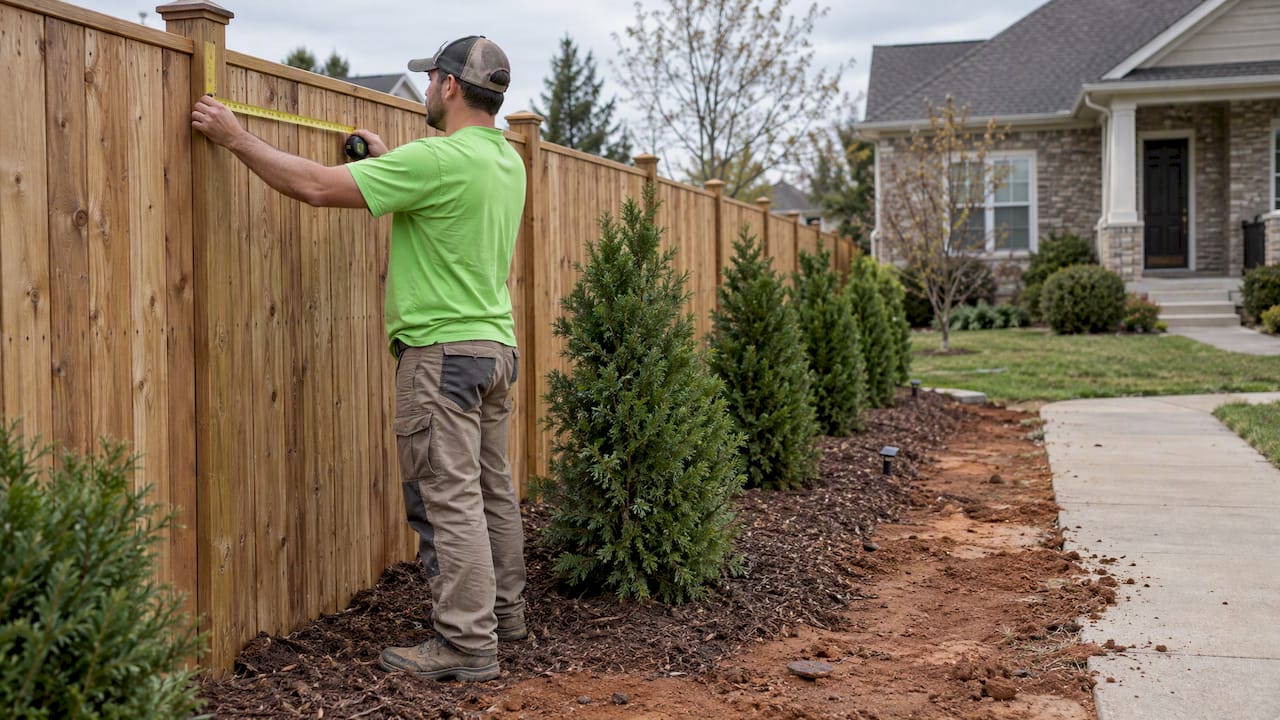
Fence height is measured from finished grade, meaning the ground level after any grading work, not the dirt level before you started. This detail trips up more homeowners than any other part of the permit process.
Here’s what that means in practice:
- If you build a raised planting bed or berm along the fence line after installation, your fence can unintentionally exceed its permitted height on paper, even though the panels themselves never changed. Document your finished grade on the permit drawings and again at final inspection to protect yourself.
- On sloped lots, installers use either a stepped approach, where panels step down in fixed increments following the slope, or a racked approach, where the top rail angles to follow the grade continuously. Some jurisdictions treat racked fences differently for height compliance since the highest point of the panel can exceed the average height measurement.
- Post depth needs to scale with height. A typical 6-foot wood fence often calls for posts set roughly 24 inches deep, while 7 to 8 foot fences may need 30 inches or more, depending on soil type and local frost line. Anything approaching 8 feet in a high-wind area is worth a quick call to a structural engineer before you pour concrete.
Pro Tip: Take a photo of your grade level and post depth before you backfill. If a zoning inspector ever questions your measured height, that photo is your evidence.
For more detail on handling grade changes across a sloped yard, see how a fence on a slope needs different planning than a flat lot, and check post depth recommendations before finalizing your materials list.
Does Fence Height Differ for Residential vs. Commercial Properties?
Residential and commercial properties operate under different assumptions, and mixing them up leads to a lot of wasted planning. A residential backyard fence answers to zoning code built around neighbor privacy and lot size. A commercial property, or a residential lot sitting next to one, often falls under a different set of rules entirely, sometimes allowing taller fencing specifically because the adjacent use generates more noise or requires more security.
For a typical single-family home, 6 feet in the back and 3 to 4 feet in front covers the vast majority of situations, whether the purpose is blocking a neighbor’s view, containing pets, or simply defining the yard. A home backing onto a commercial parking lot or a multi-family development sometimes qualifies for extra height in that specific rear section, even while the rest of the property follows standard residential limits.
Purpose matters as much as property type. A fence meant purely for decorative boundary marking rarely needs to exceed 4 feet. A fence meant to block a security light, muffle traffic noise, or create a private outdoor living area for entertaining generally performs best at the full 6-foot mark, since that’s roughly the height needed to block a standing adult’s direct line of sight. If your goal is a fully private backyard retreat, pair your fence height decision with a broader look at how the rest of your outdoor living space will function around it.
How Does Fence Height Affect Neighbor Relations?
Fence disputes rarely start with the fence itself. They start with a surprise, one neighbor waking up to a crew installing 8 feet of solid wood two feet from the shared property line, with zero conversation beforehand.
A quick heads up before construction, even just a text or a knock on the door, heads off most conflicts before they start. Sharing your planned height, your timeline, and confirming which side of the property line the fence sits on turns a potential dispute into a non-event. It also matters legally in some areas: several states have “good neighbor fence” laws or spite fence statutes that specifically address fences built at excessive height with no purpose other than blocking a neighbor’s light or view.
Height asymmetry causes its own friction. A 6-foot fence that looks reasonable from your yard can feel like a wall from the neighbor’s side if their lot sits several feet lower. Walking the property line together, or at least looking at the grade difference before you commit to a height, prevents the kind of dispute that ends up in front of a homeowners association board or, in rare cases, a small claims court. When in doubt, err toward the height that solves your privacy need without maximizing it, since the difference between 6 and 8 feet is rarely worth a damaged relationship with the people living next door.
Which Fence Materials Support the Tallest Privacy Heights?
Not every material scales to 8 feet the same way, and the material you choose often decides your realistic height ceiling before code even enters the conversation.
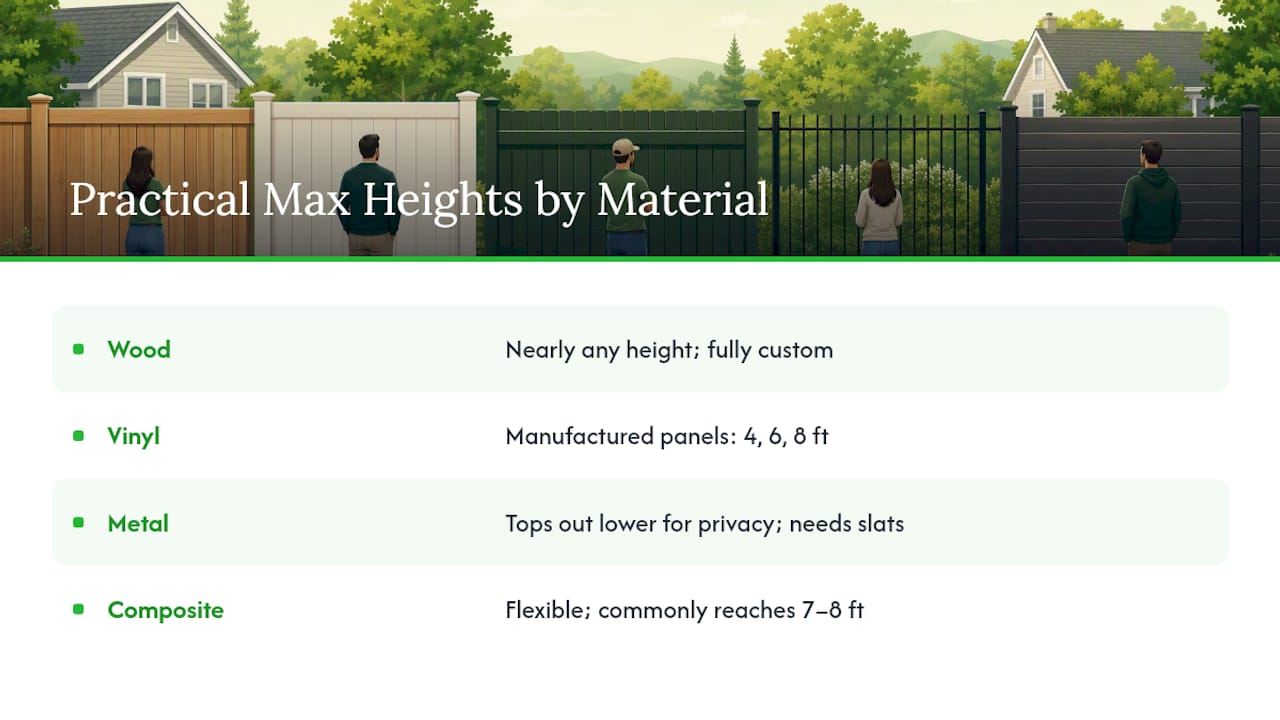
Wood remains the most adaptable option for custom heights, since boards and rails can be cut and assembled to nearly any dimension a homeowner wants. The tradeoff is that taller wood fences need more robust framing, deeper post embedment, and periodic maintenance to keep boards from warping under their own increased surface area exposed to wind.
Vinyl fencing typically comes in manufactured panel heights, most commonly 4, 6, and 8 feet, with limited ability to customize beyond those standard sizes. Going from a 6-foot vinyl system to 8 feet usually means ordering an entirely different product line rather than extending the one you already have.
Metal, including aluminum and wrought iron styles, tends to top out lower for true privacy purposes since most metal fencing is designed with gaps between pickets rather than a solid privacy screen. Taller metal privacy options exist but usually rely on added privacy slats or mesh inserts, which changes both the look and the wind load calculation.
Composite materials split the difference, offering more flexibility than vinyl’s fixed panel sizes while requiring less long-term upkeep than wood. If your top priority is reaching 7 or 8 feet without sacrificing durability, composite and well-engineered wood systems tend to give contractors the most room to work with.
How Should Fence Height Change on a Sloped Yard?
A flat-lot height rule doesn’t automatically translate to a sloped one, and this is where a lot of DIY fence projects run into trouble. If your yard drops or rises significantly along the fence line, you need to decide between two installation approaches before you settle on a final height.
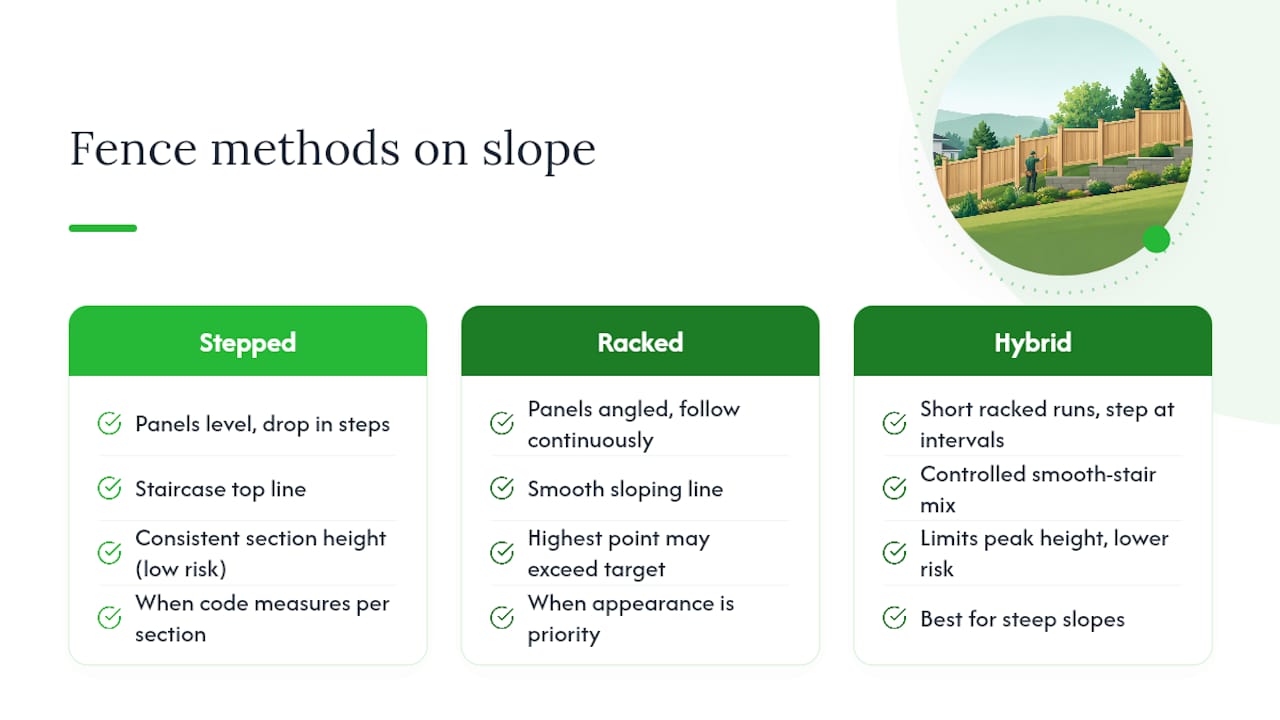
Stepped installation keeps each panel level and drops the whole panel down in fixed increments to follow the slope, creating a staircase effect along the top of the fence. This approach keeps every section at a consistent, code-compliant height, which matters if your city measures height per section rather than as an average.
Racked installation angles the top and bottom rails to follow the slope continuously, creating a smoother line without the stair-step look. The catch is that the highest point of a racked panel can end up taller than your target height, which sometimes creates a compliance problem even though the average height across the panel looks fine on paper.
For steep slopes, a hybrid approach often works best: rack shorter sections and step down at set intervals to control both appearance and measured height. Whichever method you choose, confirm with your building department how they define “height” on sloped terrain, since some measure from the lowest adjacent grade and others average across the panel. Getting this detail from a contractor experienced with slope installations before you order materials prevents a costly rebuild.
How Do You Keep a Tall Privacy Fence From Looking Like a Wall?
The tallest fence on the block isn’t automatically the best-looking one. A solid 8-foot wall of flat panels can feel heavy and institutional, while a well-planned 6-foot fence with the right design details often reads as more private simply because it’s better integrated with the yard around it.
Horizontal board fences and board-on-board designs create visual interest that breaks up a tall, flat plane, making the height feel less imposing from both sides of the property line. Staggered picket heights or alternating panel styles achieve a similar effect while still blocking sightlines effectively.
Landscaping does real work here too. Layering shrubs, ornamental grasses, or a narrow planting bed along the base of the fence softens the transition between fence and ground, and a few strategically placed trees can extend privacy above the fence line without needing extra height at all. This matters most for corner lots and front yards, where code limits you to 3 or 4 feet but you still want a sense of enclosure; the fence sets the boundary, and the plantings finish the privacy job legally.
If your fence plan is part of a larger yard redesign, coordinate the height decision with your broader landscape design so the fence, plant beds, and any patio or seating areas work together rather than competing for attention.
Contractor Perspective: What We Check Before Anyone Digs a Post Hole
Most fence height problems get created long before installation day, usually in a consultation nobody bothered to have. Precision Outdoor Solutions walks every property line with the survey in hand, checks finished grade against the permit drawings, and flags sight-triangle zones near driveways before a single post gets marked.
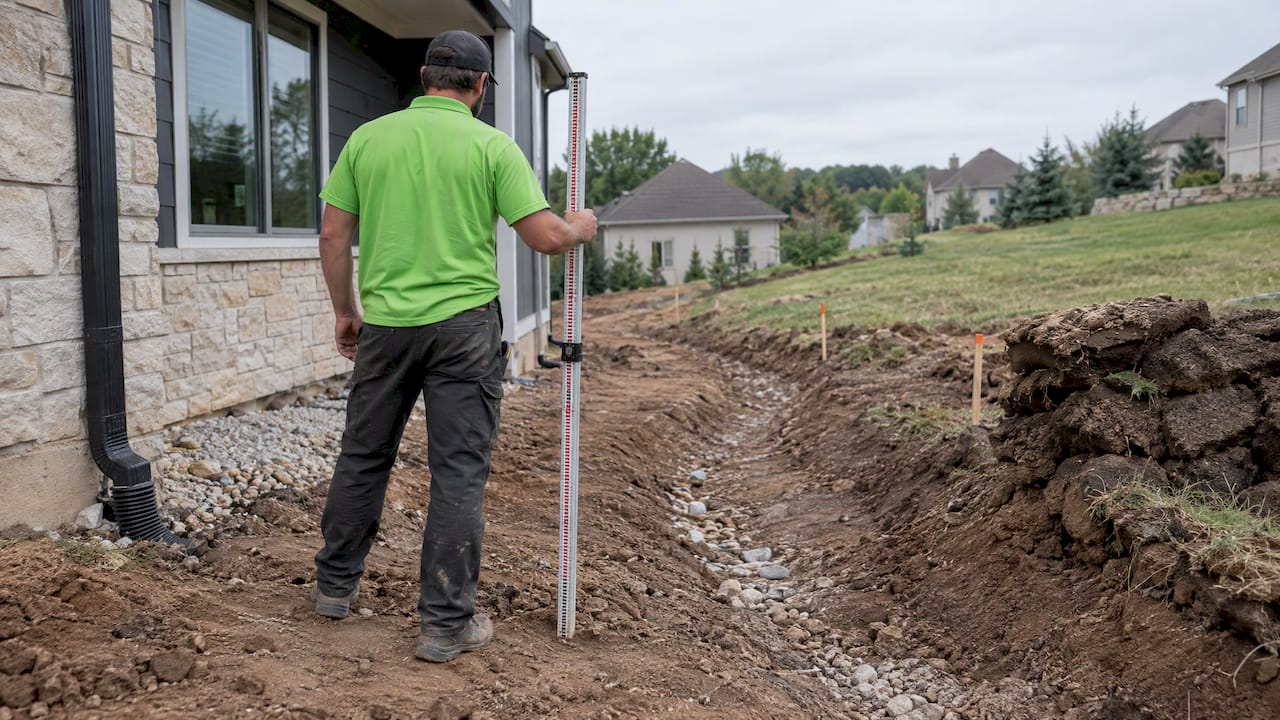
The most common fix isn’t dramatic: a grade adjustment here, a shift in post spacing there, or documenting an existing drainage swale so it doesn’t get misread as a height violation later. Permit approval timelines vary by jurisdiction, but building in a buffer of a few weeks before your installation date keeps the whole project from stalling on paperwork.
Get Your Fence Height Right the First Time With Local Help
Getting a fence height right on paper is one thing. Getting it built to match, with the correct post depth, the right grade measurements, and a design that actually looks good, is where most DIY plans run into trouble. Precision Outdoor Solutions handles the parts homeowners in Wentzville and St. Charles County find most frustrating: pulling permit documentation, confirming sight-triangle setbacks, and building to the structural standard a taller fence actually needs.

With more than 25 years of hands-on experience across the region, our team walks your property before any materials get ordered, catching grade issues and code conflicts while they’re still cheap to fix. You get a clear installation timeline and regular updates, not a surprise change order halfway through the project. If a fence is part of a bigger yard plan, we handle that scope too, from drainage corrections to the fence itself.
Ready to find out what height actually works for your property? Schedule a fence consultation with Precision Outdoor Solutions and get a plan built around your yard, your code, and your budget.
Where to Verify Your Local Fence Height Rules
Start with your city or county building department, such as St. Louis’s permit page, and your municipal planning office, like Traverse City’s zoning page, for zone-specific limits. Save any ordinance excerpts you find, and request clarification in writing whenever a rule seems ambiguous for your lot.
Sources
- Privacy Fence Design and Construction: Height, Materials, and Codes | National Fence Authority
- Do You Need a Fence Permit? Complete Guide | PermitMint
- Residential construction & permits | City of St. Louis
- Planning and zoning | City of Traverse City
FAQ
Can You Have an 8-Foot Privacy Fence?
Yes, in many jurisdictions, but it usually requires a permit and sometimes a variance, and it’s typically restricted to backyards rather than front-yard placement.
Is an 8-Foot Privacy Fence Too High?
It depends on your situation: 8 feet solves privacy issues near busy roads or commercial neighbors, but it also raises materials cost, wind-load requirements, and the odds you’ll need formal zoning approval.
Can My Neighbor Put Up a 7-Foot Fence?
Whether a 7-foot fence is allowed depends entirely on local code; some jurisdictions permit it outright, others require a permit above 6 feet, and HOA rules may impose separate limits regardless of city zoning.
What Is a Good Height for a Privacy Fence?
For most backyards, 6 feet is the practical standard, since it blocks sightlines effectively while staying under the permit threshold many cities set at that same height.
Does Precision Outdoor Solutions Handle Fence Permits?
Precision Outdoor Solutions assists with permit paperwork, site surveys, and structural planning as part of the fence installation process for homeowners in Wentzville and St. Charles County.
Recommended
- Fence Setback Rules: Height Limits And Property Line Distances
- Ask For Post Depth: Contractor Backed Fencing Advice For Homeowners
- Pick The Right Fence For Your Slope: Rack Up To 12–15° For Homeowners
This article was prepared with AI assistance for general information. For recommendations specific to your property, contact Precision Outdoor Solutions. Call or text us at (636) 358-8644.