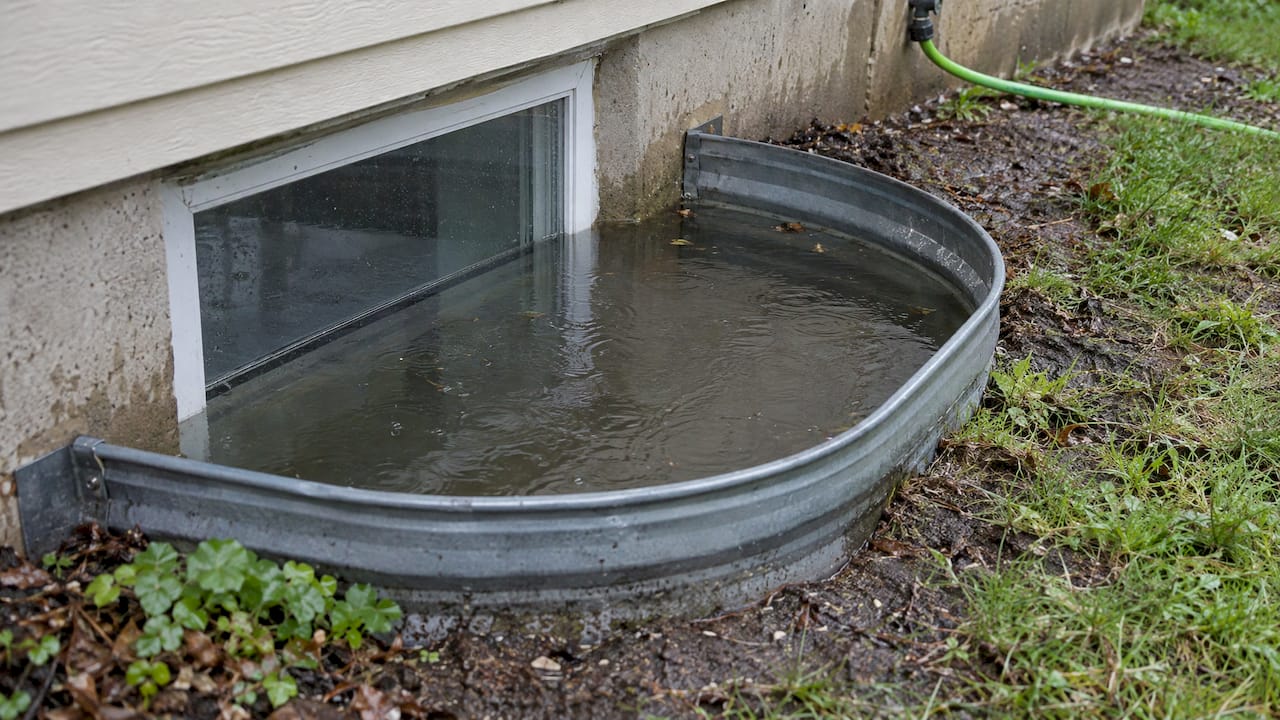
Water near your foundation is a problem worth fixing, especially when it stays after the rain stops. Soil next to the house gets saturated, and that water can move through the foundation wall toward your interior. Most cases come down to three things: ground that slopes toward the house, downspouts that dump water too close, and hard surfaces that tilt the wrong way. All three can be corrected, and the first two are often straightforward.
This guide explains how far water should be kept from your home, what proper grading looks like in numbers, how to find the source of the water, and which fixes fit which situation. We are Precision Outdoor Solutions, a landscaping and drainage contractor serving Wentzville and St. Charles County, so we also cover when a job is bigger than a weekend project.
TL;DR
- Water pooling beside a foundation can saturate the soil and wick into the home, causing mold, rot and indoor air quality problems.
- Send downspout water to a sloped area more than 5 feet from the foundation, or to an underground catchment system more than 10 feet away.
- Soil should slope away from the house at least 0.5 inch per foot for the first 10 feet. Hard surfaces within 10 feet should slope away at 2%.
- Start with gutters, downspouts and low spots. If space or barriers prevent a good slope, a swale or drain is the next step.
- Standing water, soggy spots or seepage in the basement after rain are signs to get a professional assessment.
Table of Contents
- Why water next to your foundation is a problem
- How far away should water be kept from the foundation?
- Proper grading around a house, in numbers
- Find out where the water is really coming from
- Fixes, from the simplest to the most involved
- Retaining walls and slopes
- Our perspective: fix the water path before anything else
- When to call a professional
- Common mistakes to avoid
- FAQ
- Sources
Why water next to your foundation is a problem
A little rain beside the house is normal. The trouble starts when water collects there and has nowhere to go. According to the U.S. Department of Energy’s building science guidance, high-volume roof runoff that is not drained away can rapidly saturate the surrounding soil and wick through the foundation to the interior, leading to mold, rot, indoor air quality problems and reduced durability of the building.
Small details matter here. Builders’ own research notes that even minor omissions during design or construction can lead to significant water damage. A downspout that ends a foot short, or a flowerbed built up a little too high against the siding, can be enough.
There is also the question of how much water is too much. A shallow puddle that drains in a day is a different situation from a patch that stays wet for days. The difference is how long the soil stays saturated. Soil that stays wet keeps pressure and moisture against the wall. That is why we focus on getting water moving away quickly rather than only on sealing the wall.
Signs the water is already causing trouble
A municipal homeowner guide lists the common signs of drainage issues: standing water or soggy spots, water seepage in basements, and downspouts that direct water toward the house. Other things we look for on a site visit include:
- Soil that has settled into a dip right along the foundation
- Mulch or soil washed out from beds near the house
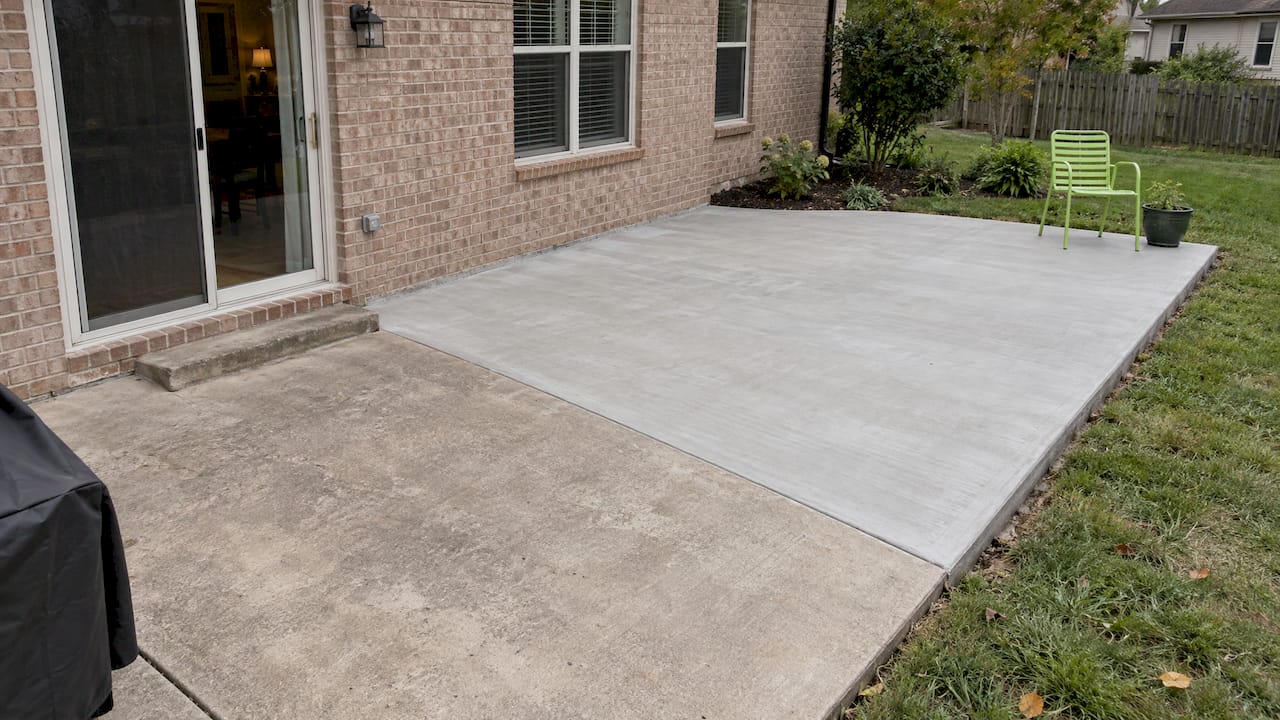
- Patios, walkways or driveways that tilt toward the house
- Gutters that overflow over the edge during a normal rain
- A musty smell in the basement or crawl space after storms
If you see more than one of these, the cause is probably a drainage pattern rather than a one-time event. Our own guide to the signs you need a drainage solution in Wentzville walks through what that looks like in local yards.
How far away should water be kept from the foundation?
The short answer is: as far as you can send it, with a minimum you should not drop below. For roof water, the Department of Energy guidance says to connect downspouts to piping that carries water to a sloping final grade farther than 5 feet from the foundation, or to an underground catchment system farther than 10 feet from the foundation.
In practice that gives you two workable options:
| Where the water goes | Minimum distance from foundation | Notes |
|---|---|---|
| Sloping final grade (surface discharge) | More than 5 feet | The ground at the outlet must slope away from the house |
| Underground catchment system | More than 10 feet | Used when surface discharge is not practical |
A short plastic splash block at the base of the downspout does not meet either number. If your downspout empties within a couple of feet of the wall, extending or piping it is the cheapest improvement on this list. For the types of extensions and buried lines, see our homeowner’s guide to downspout drainage options.
One more point: where possible, redirect downspouts to permeable areas away from foundations. Dumping the water onto a driveway or a neighbor’s lawn just moves the problem.
Proper grading around a house, in numbers
Grading is the slope of the ground. Good grading uses gravity to move rainwater away from the walls before it can soak in next to the footing. The Building America resource guide gives specific targets: permeable surfaces such as soil and lawn should slope away from the foundation at least 0.5 inch per foot for 10 feet, and impervious surfaces within 10 feet should slope away at 2%.
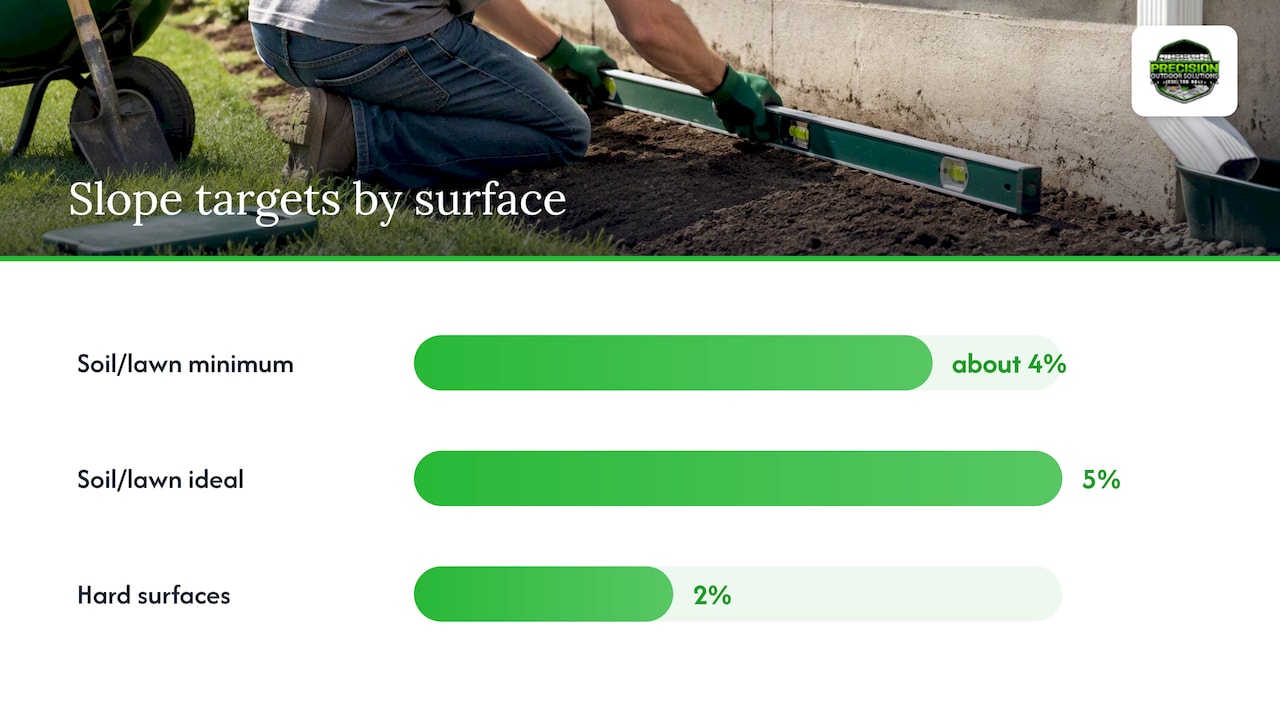
Soil and water conservation guidance says that ideally the land around the house slopes away from the foundation walls at a 5% grade for ten feet. Those two figures are close. A 0.5 inch drop per foot is about 4%, so aiming for roughly 4% to 5% for the first 10 feet is a sound target for soil and lawn areas.
Here is what that means on the ground:
| Surface within 10 feet of the house | Slope away from foundation |
|---|---|
| Soil, lawn, planting beds | At least 0.5 inch per foot (about 4%); 5% is the commonly cited ideal |
| Patio, walkway, driveway, other hard surfaces | 2% (about a quarter inch per foot) |
How to check your own grading
You do not need special equipment for a first look.
- Push a stake into the ground right at the foundation and another 10 feet out, straight away from the wall.
- Run a string between them and level it with a line level.
- Measure from the string down to the ground at the far stake. A drop of 5 inches or more over 10 feet meets the 0.5 inch per foot target.
- Repeat on each side of the house, and near every downspout.
If the ground at the far stake is the same height as at the wall, or higher, water is likely being directed toward the house. Our article on yard grading that stops runoff goes deeper on how we think about slope when a basement gets wet from yard water.
Find out where the water is really coming from
The best diagnostic tool is a rainy day. Spend time outside during and after a rain event and note where the water comes from, where downspouts flow, and whether pipes or ditches are clogged. We agree, and we would add a few habits:
- Take photos of every wet area, with something in the frame for scale.
- Note how long water takes to disappear after the rain ends.
- Watch each downspout outlet. Does the water leave in a clear path or sit in a pool?
- Look at the neighbor’s side. Water often crosses property lines.
- Check the sides of the house that get the least sun. Those stay wet longest.
That last point about neighbors is real. Neighbors can work together on drainage improvements and share the cost, but in most cases they have to settle drainage issues between themselves. Talk with your neighbor early and calmly. A shared swale along a property line often works better than two separate fixes.
Fixes, from the simplest to the most involved
Work down this list in order. Many homes only need the first two steps.
1. Clean and extend gutters and downspouts
Gutters that are full of leaves overflow right at the wall. Gutters should be cleaned free of debris at least once a year, and more often if trees are close to the house. If you have mature trees, plan for more than one cleaning in the fall. Routine cleaning of gutters, downspouts and splash pads is a basic maintenance step.
After cleaning, check that every downspout meets the distance targets above. If not, extend it or pipe it underground. Our team handles lawn and landscape maintenance for homeowners who would rather not climb a ladder every fall.
2. Fill in sunken areas and rebuild the slope
When the soil near the house has settled, it forms a bowl. The fix is to build up sunken areas or improve the yard slope so water is directed away from the home. The Building America guide describes the same idea: regrade the yard to slope away from the house.
A few practical rules we follow on regrading:
- Use fill soil that packs well, and build it up in layers rather than dumping it in one pile.
- Keep soil and mulch below the siding and any weep holes or sill plates.
- Allow for settling by leaving the finished slope slightly generous.
- Make sure the new slope has somewhere to send water, not just a new low spot at the edge of the lawn.
3. Add a swale or drain when a slope alone will not work
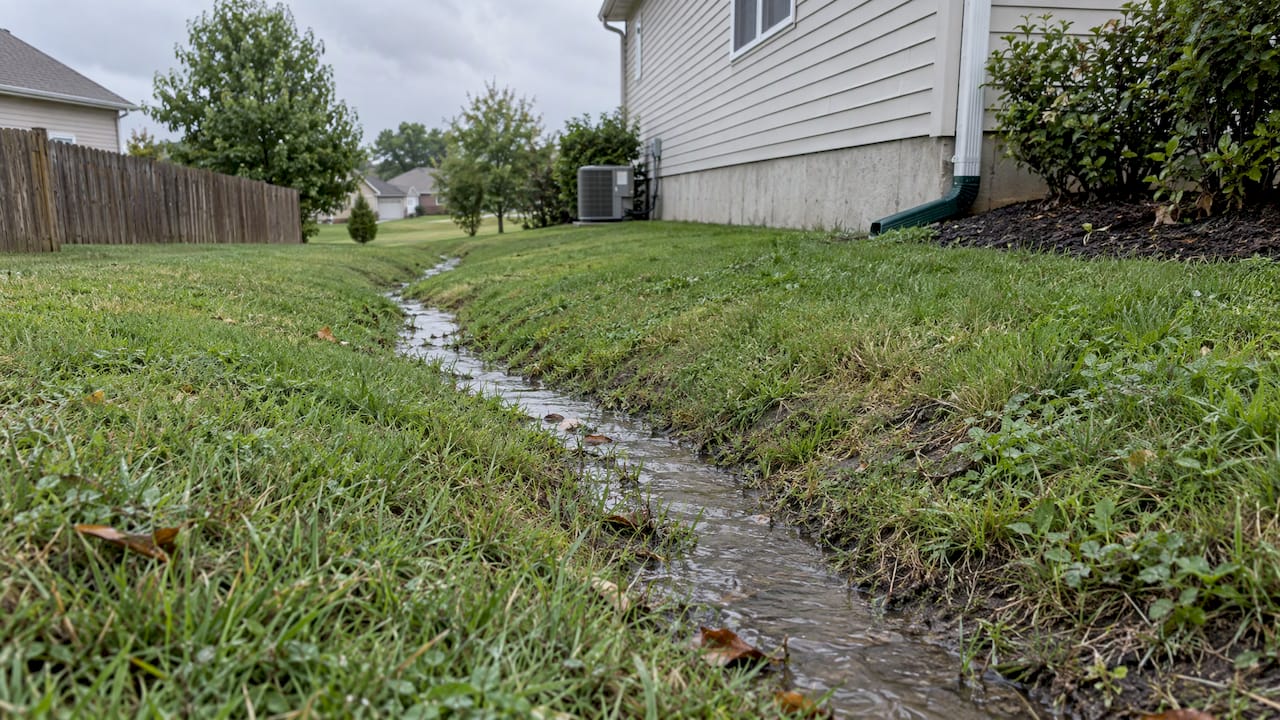
Sometimes there is not enough room. The Building America guide says that if setbacks limit space to less than 10 feet, you should install swales or drains designed to carry water away from the foundation. The same applies when barriers such as fences, walls or neighboring grades keep you from building a proper slope.
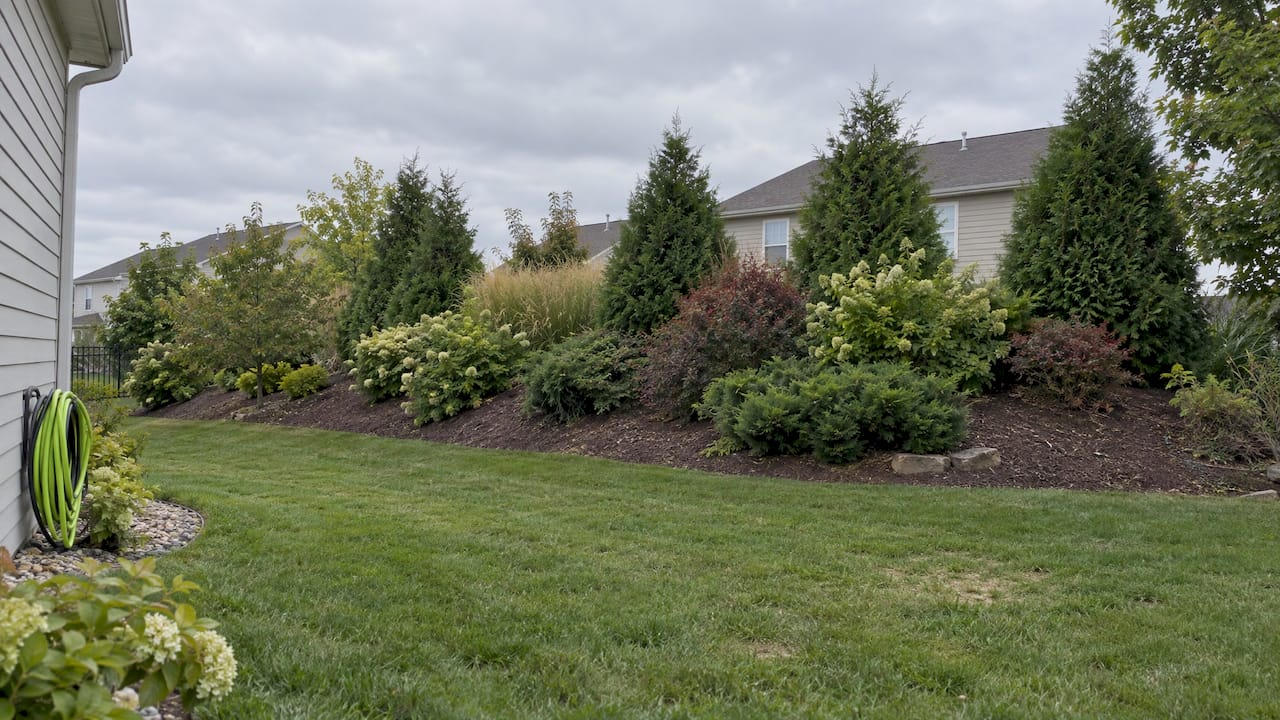
A swale is a shallow, gently sloped channel, usually grass-lined, that carries water around the house. A drain is buried pipe, often with a grated inlet at the low spot. Which one fits depends on your lot, your soil and where the water can exit. Read our breakdown of yard swale design specs for how we size and slope them.
4. Fix hard surfaces that tilt toward the house
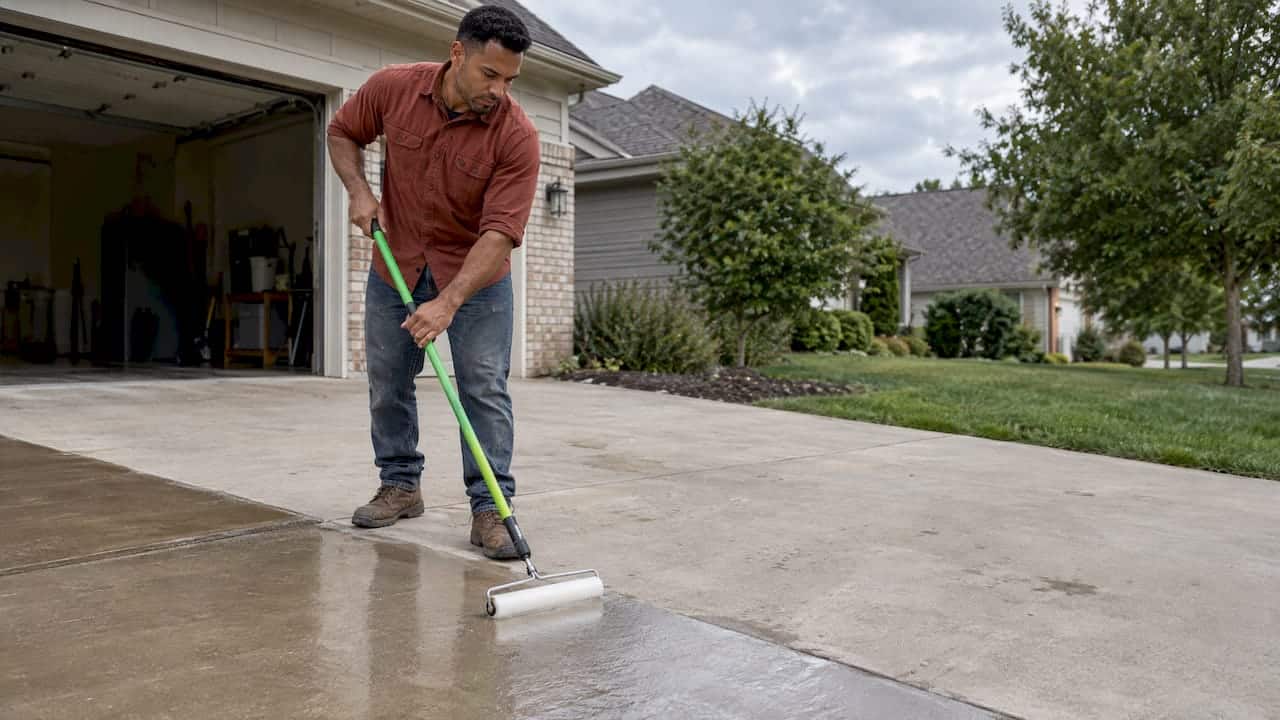
Patios, walkways and driveways shed water fast, and they send it wherever they slope. The Building America guide notes that drains can be installed at the base of driveways and patios that slope toward the house. A sidewalk that settles or tips toward a foundation may need to be replaced.
If you are planning a new patio, build the drainage in from the start. Our posts on patio drainage design with a 1.5% slope and patio drainage solutions explain how. For slabs and walks that have settled, our concrete services cover replacement. Driveways have their own challenges, covered in driveway drainage ideas.
5. Protect the wall below grade
Exterior wall treatments are the last layer, not the first. The Building America guide lists dampproofing and/or a dimpled plastic moisture barrier on the exterior surface of below-grade walls as options. These are typically installed when a wall is exposed during construction or excavation. They work best together with good grading, because they manage moisture that still reaches the wall rather than stopping the source.
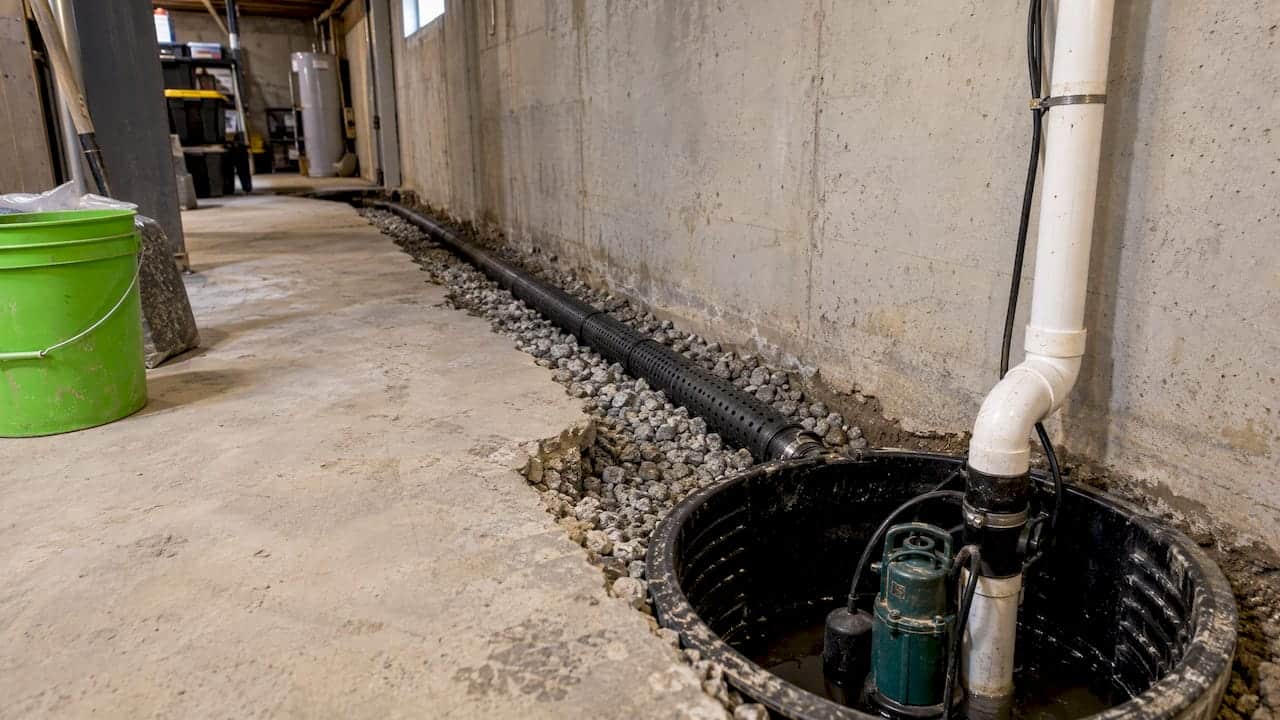
Inside the home, if moisture has already reached a basement floor, choosing finishes that handle dampness matters. These basement flooring and waterproofing tips cover what to put down once the water outside is under control.
Retaining walls and slopes
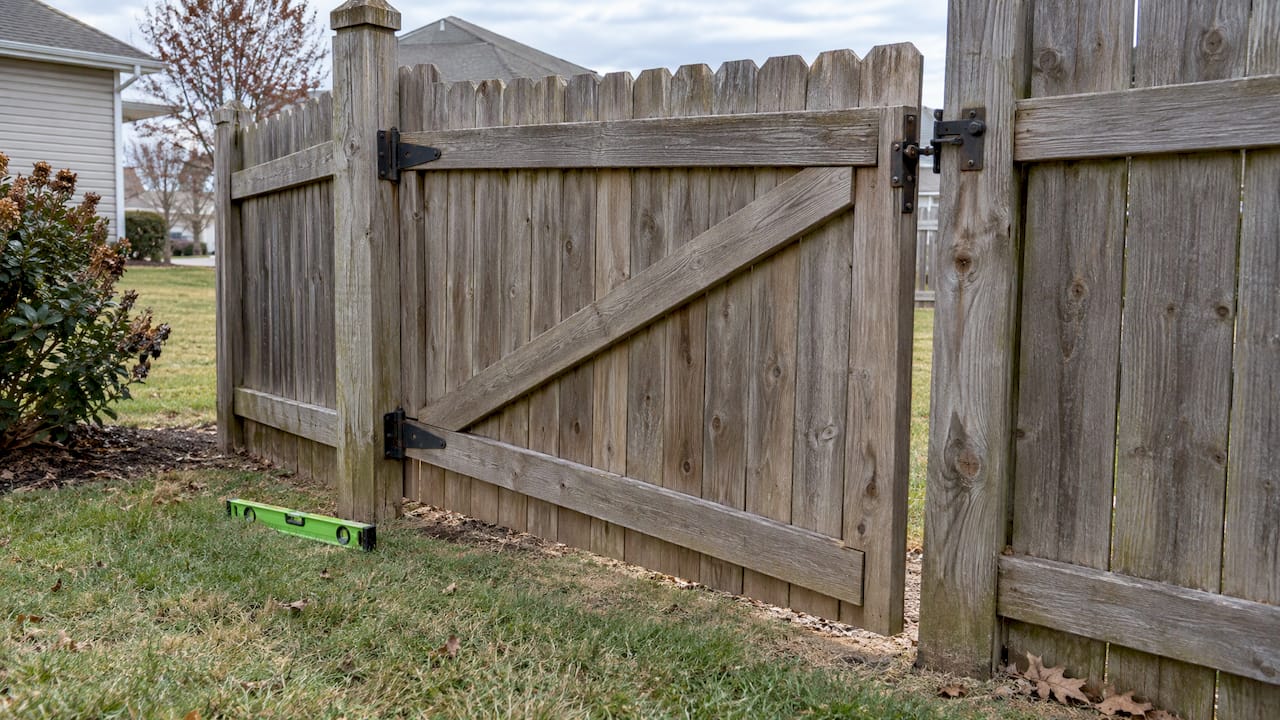
If your yard has a retaining wall near the house, water behind it needs a path out. A wall without drainage holds water against the soil, which pushes it toward the foundation or into the wall itself. We cover this in our retaining wall drainage guide. Fences on slopes can also block the natural path of runoff, so it helps to plan them with drainage in mind. See our post on fences on a slope if that applies to you.
Our perspective: fix the water path before anything else
We see the same pattern across Wentzville and St. Charles County. A homeowner calls about a patio, a fence or a new garden, and when we walk the property we find that water is the real issue. The yard slopes the wrong way, a downspout ends too close to the wall, or a beautiful new bed has been built up against the house.
That is why our design process starts with drainage. We look at how water moves across the whole property, not just the spot that looks wet. Then we plan the grading, the hardscape and the planting around it, so the finished space is durable as well as attractive.
Our approach is built on expert craftsmanship, clear timelines and regular updates, and designs tailored to each property. We pay attention to long-term stability, because a drainage fix that fails in two seasons is not a fix. If you want to see how that fits into the bigger picture, read how we solve drainage first in the landscape design process.
Precision Outdoor Solutions
When to call a professional
Many of the steps above are doable on your own. Some situations call for a contractor who can assess the whole property:
- Water keeps pooling after you have cleaned the gutters and extended the downspouts.
- There is not enough room to build a 10-foot slope, so a swale or drain is needed.
- Water is entering the basement or crawl space.
- A patio, driveway or walk slopes toward the house and needs to be rebuilt.
- The water seems to come from a neighbor’s property or a shared low area.
- The grading work would involve heavy equipment or large amounts of soil.
The Building America guide also reminds readers that, in areas prone to heavy winds, they should follow all local codes regarding site stormwater management. Check with your city or county before you change drainage patterns significantly, and especially before sending water toward a property line.
How Precision Outdoor Solutions can help
Our drainage work starts with a site consultation, where we look at grading, downspouts, hard surfaces and the path water takes across your yard. From there we plan a solution that fits your property, whether that is regrading, a swale, a buried drain, or a rebuilt patio or walk. We serve homeowners in Wentzville, St. Charles County, and nearby communities including St. Peters, O’Fallon and Troy.

Learn more about our yard drainage solutions in Wentzville, MO, or browse the rest of what we do on our services page. If you want a landscape plan that treats water first, our landscape design service is the place to start. You can reach us through Precision Outdoor Solutions to set up a consultation.
Common mistakes to avoid
- Piling mulch or soil against the house. It holds moisture against the wall and can raise the grade above the intended slope.
- Ending downspouts at the foundation. Splash blocks alone rarely carry water far enough.
- Ignoring hard surfaces. A patio that tilts toward the house moves a lot of water in a short time.
- Creating a new low spot. Regrading that pushes water to the edge of the yard can flood a neighbor or your own fence line.
- Treating only the symptom. Sealing a basement wall without fixing the yard leaves the source untouched.
- Skipping the rainy-day check. Dry-weather guesses often miss where water actually travels.
FAQ
Will water next to my house foundation cause a problem?
It can. When roof runoff or yard water is not drained away, it can saturate the soil and wick through the foundation, which the U.S. Department of Energy’s building science guidance links to mold, rot and poor indoor air quality. A brief puddle that clears quickly is less of a concern than water that sits for days. If you see repeated pooling, address the source.
How do I get rid of water around my foundation?
Start by cleaning gutters and extending downspouts so water leaves well away from the wall. Then check the grading and fill in any low spots so the ground slopes away from the house. If space or barriers limit your options, a swale or drain can carry the water away.
How far should water be from the foundation?
Federal building science guidance says downspouts should discharge to a sloping grade more than 5 feet from the foundation, or into an underground catchment system more than 10 feet away. The ground itself should slope away from the walls for the first 10 feet.
Will insurance cover water coming in around my foundation?
Coverage depends on your specific policy and on how the water got in, so there is no single answer. Ask your insurance agent or carrier directly, and ask them to point to the exact policy language on surface water and seepage. Fixing the drainage outside is the step that reduces the chance of a repeat problem either way.
Sources
- Foundation Drain Gutters Downspouts, Building Science, U.S. Department of Energy
- Final Grade Slopes Away from Foundation, Building America Solution Center
- Rain and Groundwater Management: Reducing the Risk of Water Damage, NAHB
- Basement Flooring Ideas and Waterproofing Tips
Recommended
- Stop Yard Runoff: 1 Inch Per Foot Grading Homeowners Need
- 1.5% Slope And A Soil Test: Patio Drainage Design For Homeowners
- Driveway Drainage Ideas That Actually Prevent Water Damage
- Patio Drainage Solutions That Actually Stop Water Pooling
This article was prepared with AI assistance for general information. For recommendations specific to your property, contact Precision Outdoor Solutions. Call or text us at (636) 358-8644.