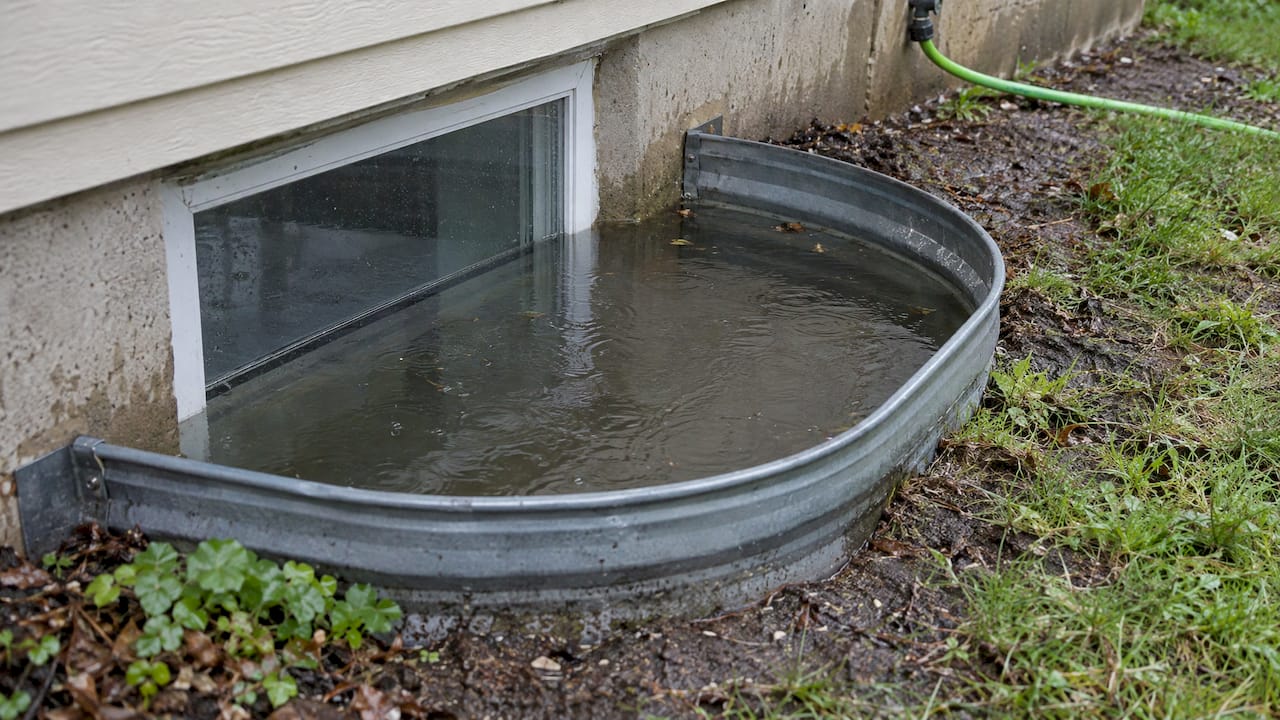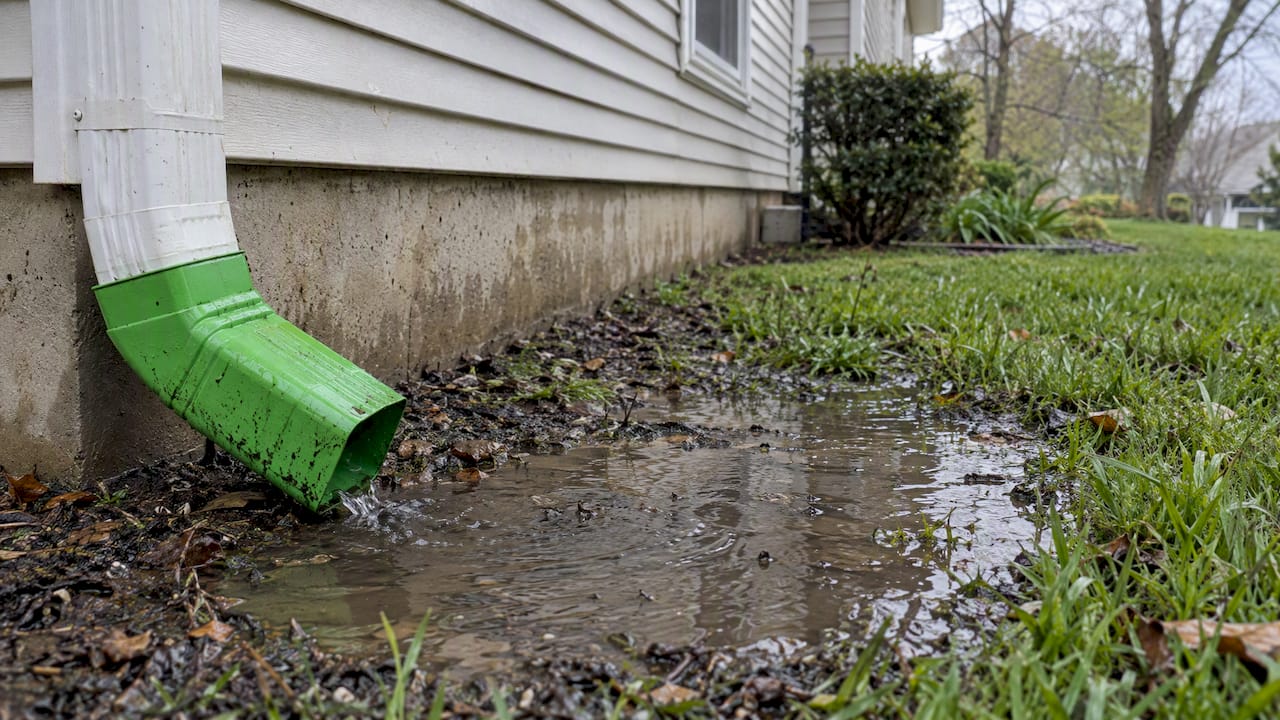
Concrete steps on a slope work well when three things are right: the math (rise and run), the ground under them (base, drainage and frost depth), and the finish (a safe, slip-resistant surface). Get those right and a hillside becomes a path you will use for decades. Skip one and the steps heave, crack or turn slick within a few winters.
We build and repair outdoor spaces across Wentzville and St. Charles County, so this guide leans on Missouri conditions. It covers how to figure out how many steps you need, what code asks for, how to keep water from wrecking the job, what it costs, and how to fix steps that are already crumbling.
TL;DR
- Wentzville lists a 30-inch frost line depth, so footings and base prep matter as much as the concrete itself.
- Water is what usually kills steps. Plan drainage first, then the stairs.
- Check with the Wentzville Building Division before you start. Permit rules depend on the project.
Table of Contents
- Start with the slope: how many steps do you need?
- What code requires for outdoor concrete steps
- The ground matters more than the concrete
- Poured-in-place or precast?
- Making the steps safe and durable
- What concrete steps on a slope cost
- Fixing crumbling concrete steps
- Our perspective
- When to hire a pro, and what to expect
- FAQ
- Sources
Start with the slope: how many steps do you need?
Every set of steps comes down to one measurement: the total vertical drop from the top of the slope to the bottom. Everything else follows from it.
- Measure the total rise. Set a straight board or string level at the top of the slope, extending out over the low point. Measure from the string straight down to the ground where the bottom step will land.
- Pick a target riser height. Code caps it, but most people find 6 to 7 inches more comfortable than the maximum.
- Divide. Total rise divided by target riser gives the number of risers. Round to a whole number, then divide the total rise by that whole number to get the exact riser height.
- Set the tread depth. Use at least 10 inches. On a hillside, 11 to 12 inches feels more natural and gives your foot room.
- Check the horizontal run. Multiply the number of treads by the tread depth and add landings. If it does not fit the space, the path needs to switch back or turn.
A worked example
Say your slope drops 48 inches. At a 7-inch target, 48 ÷ 7 is about 6.9, so you round to 7 risers. Each riser is then 48 ÷ 7, or about 6.86 inches. With 7 risers and 11-inch treads, you have 6 treads between the top and bottom landings, which is 66 inches of horizontal travel, a bit over 5 feet, before you add the landings.
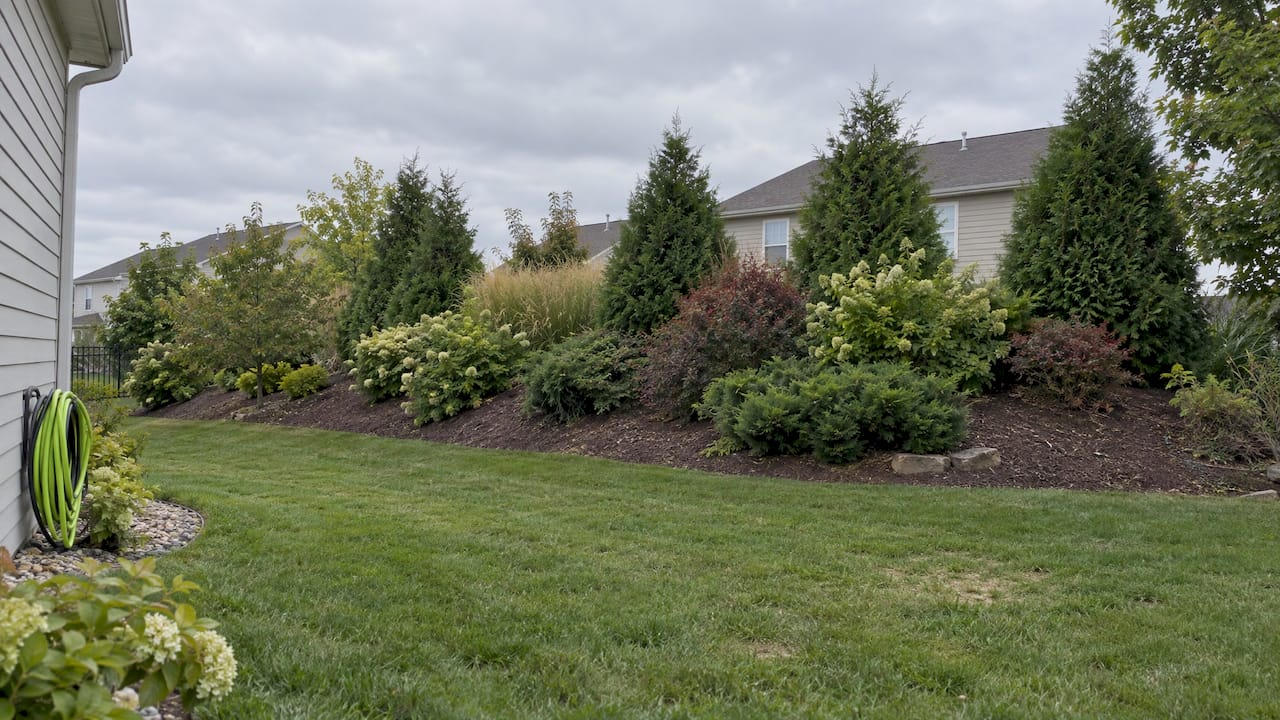
Now the steep case. A homeowner in one Reddit thread was told a very steep hill would need roughly 30 steps at a 7-inch rise. That is a lot of concrete and a lot of cost. On a slope that steep, a straight run is rarely the best answer. Switchbacks, intermediate landings or terracing usually look better and cost less to build and maintain. Our guide to terraced yard ideas shows how to break a hill into usable levels.
What code requires for outdoor concrete steps
Check your own jurisdiction, but Wentzville has adopted the 2021 International Residential Code with local amendments. A published IRC stairs guide lists these key numbers for exterior stairs:
| Requirement | Limit |
|---|---|
| Maximum riser height | 7.75 inches |
| Minimum tread depth | 10 inches |
| Riser variation within a flight | No more than 3/8 inch |
| Walking surface slope (for drainage) | No steeper than 2% |
| Landing depth at top and bottom | At least 36 inches in the direction of travel |
These figures come from a county residential stairs handout built on the IRC. Another sample code excerpt sets the minimum stairway width at 36 inches above handrail height. Handrail and guard rules depend on how tall the stairs are, so ask the building official what applies to yours.
The 3/8-inch riser tolerance is the one people miss. On a sloped site, it is easy to end up with a short first or last riser because the ground is uneven. Your eye and your foot both catch it, and it is the classic trip hazard.
The 2% surface slope does not mean steps should be flat. Treads need a slight pitch so rain runs off. A long-standing forum answer from tradespeople puts it at about 1/4 inch of pitch is plenty, which fits comfortably under that 2% cap. We would rather not rely on a forum, so treat the code number as your limit and ask your contractor how they form the pitch.
Do you need a permit in Wentzville?
The city’s building FAQ says permits are explicitly required for driveways and work affecting street intersections, while patios and other non-driveway slabs often do not need one. Steps on a slope are a gray area because height, handrails and retaining elements can change things. Call the Building Division with your address and a sketch. It is a quick call and it protects you at resale.
The ground matters more than the concrete
Most failed steps were not poorly mixed. They were poured on poor ground.
Frost and base
Missouri freezes and thaws repeatedly. Wet soil expands as it freezes and lifts the concrete. Engineering guidance for exterior stairs stresses placing foundations below the frost line and using free-draining fill so the ground stays stable year-round. For Wentzville, the frost line is 30 inches per the city’s design parameters.
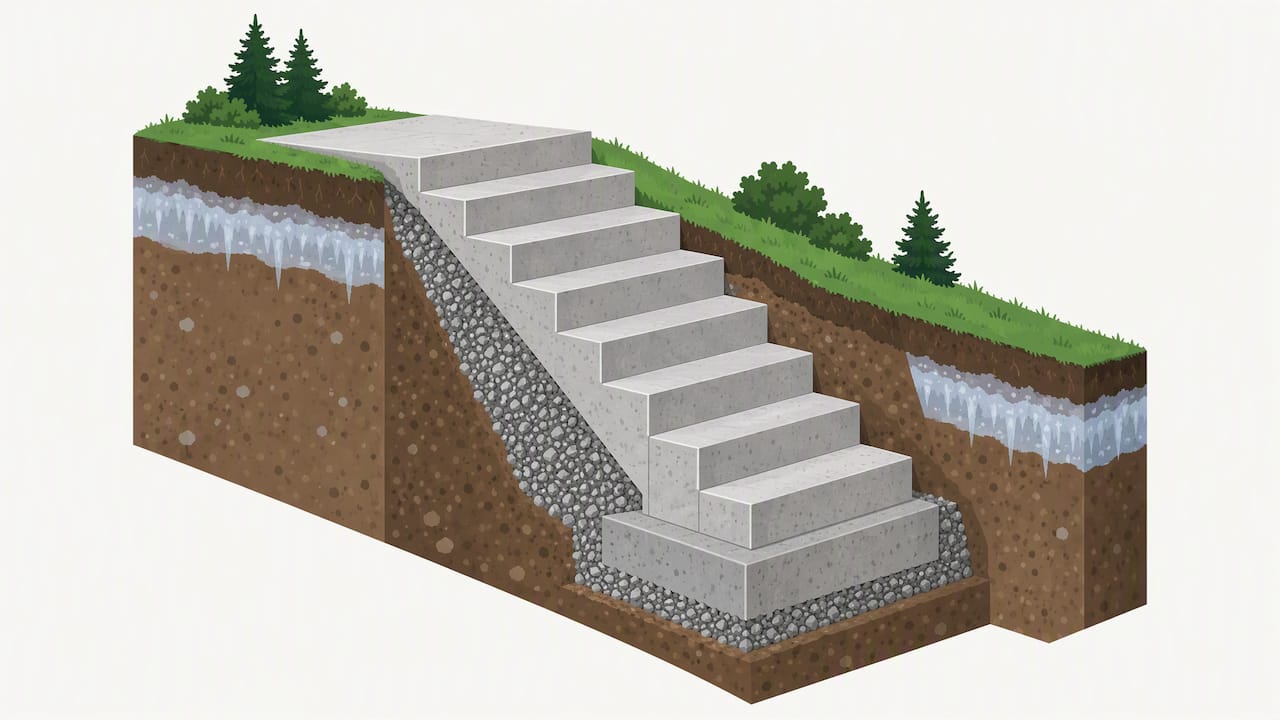
For the base, a building science digest describes compacting at least 6 inches of granular material to give concrete a stable, free-draining bed. If you are curious how this works on flatwork, our patio base preparation guide walks through the same principles.
Drainage behind and beside the steps
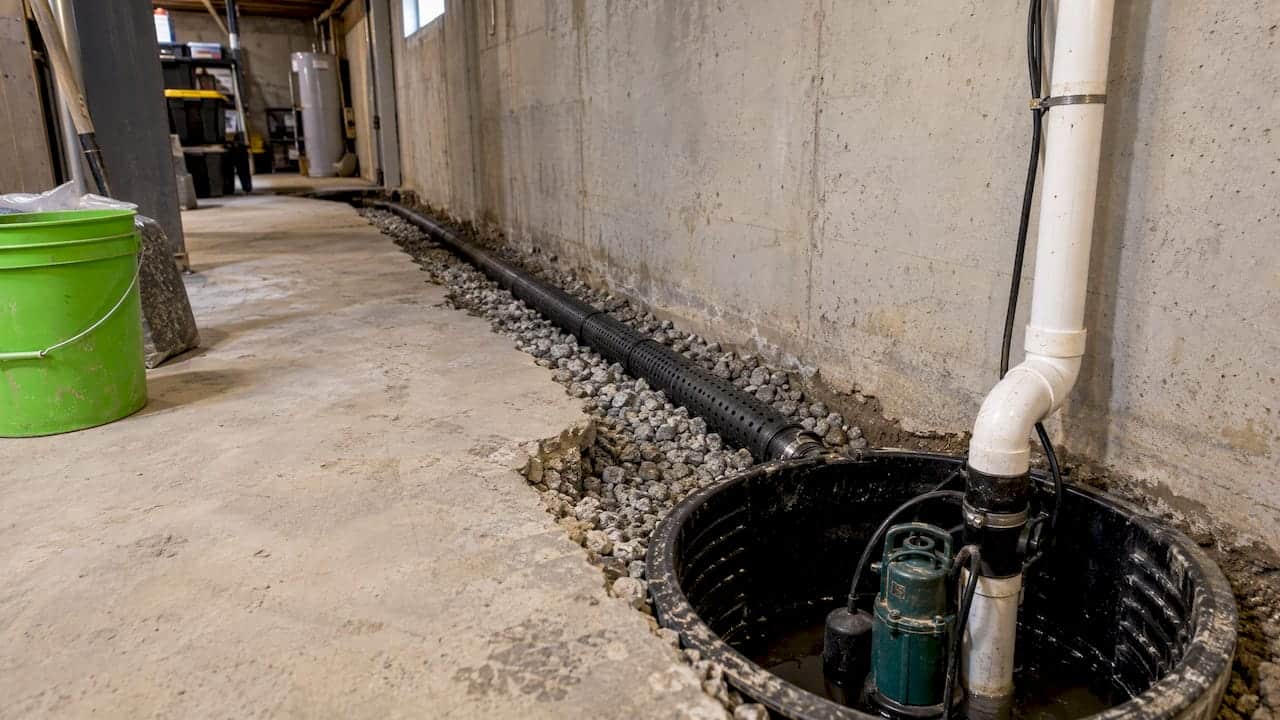
A slope sends water downhill, and your steps are in the way. The same SUNY guidance recommends a perforated underdrain wrapped in filter fabric behind retaining elements or along the base of the steps. That relieves the water pressure that builds against the concrete.
Three practical checks before any concrete is poured:
- Where will it go? Water needs an exit at the bottom of the steps, not a pocket where it sits and freezes.
- Is the soil already moving? Bare, eroding slopes undermine steps from the side. See our notes on slope erosion control.
If your yard already holds water, solve that first. Our signs you need a drainage solution article shows what to look for.
Poured-in-place or precast?
Both are legitimate. Which fits depends on your hill.
| Precast | Poured-in-place | |
|---|---|---|
| Speed | Faster installation | Longer, needs forming and curing |
| Cost | Usually lower | Usually higher |
| Fit to slope | Standard sizes, limited flexibility | Shaped to your exact grade |
| Look | Uniform | Integrated with walls, landings and paths |
National cost guides note that precast units are factory-made and quicker, while poured-in-place sets match the topography more closely. On a gentle, straight slope, precast can be a smart budget choice. On an uneven hillside with curves, a change in width or a retaining wall alongside, poured-in-place usually gives a cleaner result.
Making the steps safe and durable
Finish decisions are cheap at the start and expensive later.
- Broom finish. A textured surface gives grip when wet. Smooth troweled concrete is a slip risk.
- Metal nosings. University construction standards treat cast-in-place metal nosings as a way to get a clearer, tougher leading edge that resists the chipping and rounding of bare concrete. Worth asking about for steps that get heavy use.
- Lighting and visible edges. A step you cannot see at night is the one you miss. Low path lights or marked nosings help.
- Even risers. Walk the form before the pour. Fixing a 1/2-inch error in wet concrete takes minutes. Fixing it after takes a jackhammer.
What concrete steps on a slope cost
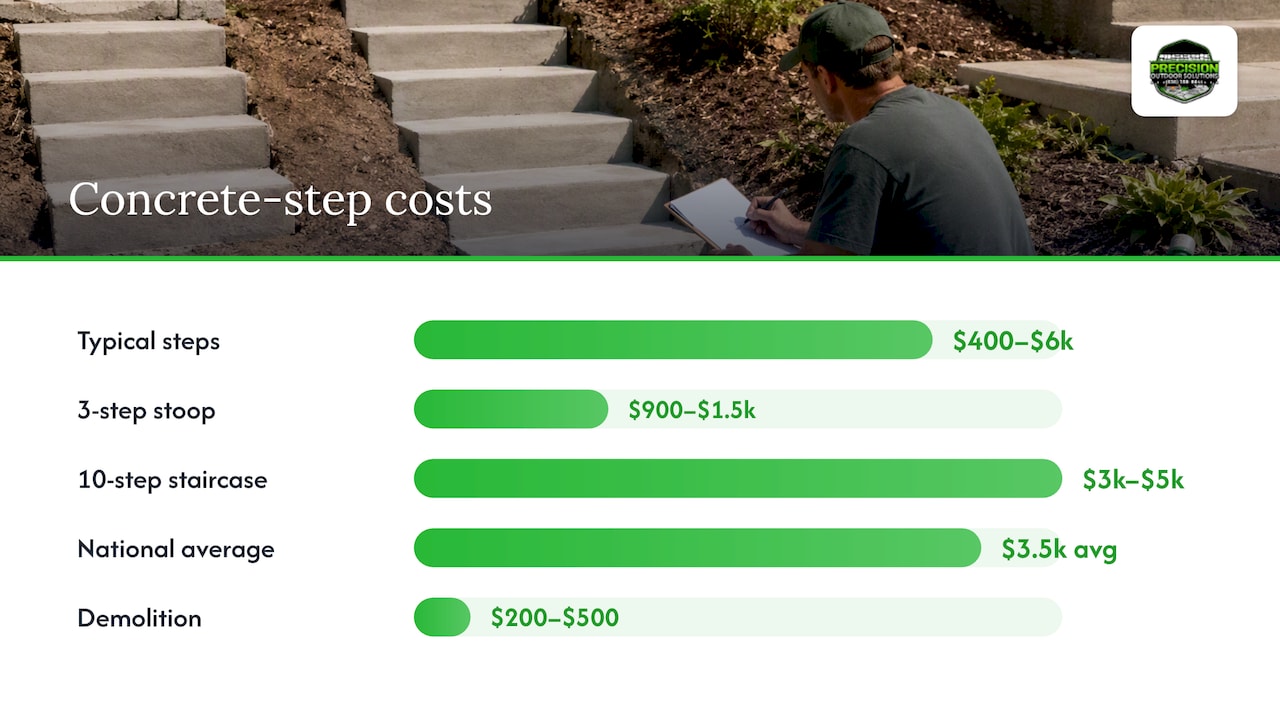
National cost guides report concrete steps typically run $400 to $6,000, with a $3,500 national average. A standard 3-step front stoop falls between $900 and $1,500, and a 10-step custom staircase between $3,000 and $5,000. Demolition of old steps adds roughly $200 to $500. Those figures include labor, materials and finishing.
Sloped sites usually land higher because of excavation, drainage, extra forming and sometimes retaining walls. Width, curves and decorative finishes push the price up too.
When you compare quotes, ask each contractor:
- Does the price include site prep, excavation and removal of existing steps?
- How deep is the base, and what material is it?
- What reinforcement is used (rebar or mesh)?
- How is drainage handled behind and below the steps?
- Does the quote cover any permit?
We do not publish set prices for our work because every slope is different. We give a clear written estimate after seeing the site. If you are budgeting a bigger yard project at the same time, drainage and hillside work can be sequenced together to avoid tearing up finished work. A plumbing cost page like this sewer line replacement guide is a reminder to locate buried lines before any excavation, so call 811 before digging.
Fixing crumbling concrete steps
Crumbling steps are the second thing readers search for, and the answer depends on the cause.
Surface flaking or small chips. Often from freeze-thaw cycles and de-icing salt on a thin or poorly finished surface. Small areas can be patched with a repair mortar, and a sealer slows further damage. Patching sticks best when the loose concrete is cleaned out first.
Rounded or broken edges. Bare concrete nosings wear and chip. Repair is possible, but if the steps are otherwise sound, rebuilding the edge with a harder profile may last longer.
Cracks, tilting or gaps against the house. This points to the ground, not the surface. Water has likely washed out or frozen the base. Patching will not hold. The steps need to be lifted or replaced with a proper base and drainage.
Water pooling at the bottom or behind the steps. Fix that first, or the new steps will fail the same way.
A good rule: if a patch needs to be redone within a season, the problem is underneath. Our patio repair options article explains how to tell a DIY fix from one that needs a pro, and the same logic applies to steps.
Our perspective
On a slope, we start with water and soil, not with the steps themselves. Every hillside we see in Wentzville and St. Charles County has a drainage story, and the steps have to fit into it. If the water path is ignored, even beautiful steps end up cracked within a few winters.
We also like to set expectations early. A homeowner should know the number of steps, the tread and riser sizes, where the water will go, and what the surface will feel like in the rain before anything is poured. Clear timelines and regular updates matter as much as the craftsmanship, because nobody wants a torn-up hillside sitting for weeks.
If steps are only part of the picture, a retaining wall, a terrace or a patio at the top may do more for how you use the yard. We would rather talk through the options with you than sell you more concrete than you need.
, Precision Outdoor Solutions
When to hire a pro, and what to expect
Hire a contractor when the drop is more than a few steps, when the slope is eroding or wet, when the steps connect to a house entry, or when you need to match code. Even national cost guides say the elevation, leveling and forming work is too complex for DIY on most steps.
With Precision Outdoor Solutions, the process is a site consultation, a design plan with material selection, and professional installation. Our Concrete Services cover steps and flatwork for homes in Wentzville and across St. Charles County, and our Hardscape & Patio Installation team can build the landing or patio the steps lead to. If drainage is the real issue, see our Yard Drainage Solutions. To talk about your hillside, contact us for an estimate.
For related reading, see our guide to patio step options and codes and our overview of how to choose a hardscape contractor.
FAQ
How do I calculate the number of steps on a slope?
Measure the total vertical drop, divide it by a riser height near 7 inches, and round to a whole number. Then divide the drop by that whole number to get the exact riser. The IRC caps risers at 7.75 inches, and every riser in a flight should match within 3/8 inch.
Can you pour concrete on a slope?
Yes, but the ground must be prepared first. That means excavating, compacting a granular base, forming the steps level and square, and planning drainage. On steeper hills, the steps are formed into the grade with landings, and sometimes a retaining wall holds the soil beside them.
How much do 3 concrete steps cost?
A professionally installed 3-step front stoop typically costs $900 to $1,500, including forming, base prep, reinforcement and finishing. A slope, extra width or old steps to remove will raise the quote. Ask whether site prep and demolition are included.
Do concrete steps need a permit in Wentzville?
It depends on the project. The city says permits are clearly required for driveways and work near street intersections, and often not for patios and non-driveway slabs. Call the Wentzville Building Division with your address to confirm for your steps.
Sources
- Building Codes, City of Wentzville
- Building FAQ, City of Wentzville Building Division
- Program Directive 2-9 Exterior Walls and Stairs, SUNY
- CBD-156 Drainage Around Buildings
- Design and Construction Standards, Division 03 Concrete, Eastern Michigan University
Recommended
- 5 Patio Step Options For Homeowners: Costs, Codes, When To Hire
- Terraced Yard Ideas That Turn A Slope Into Usable Space
- Retaining Walls For Slopes: Your Complete Planning Guide
- 1.5% Slope And A Soil Test: Patio Drainage Design For Homeowners
This article was prepared with AI assistance for general information. For recommendations specific to your property, contact Precision Outdoor Solutions. Call or text us at (636) 358-8644.