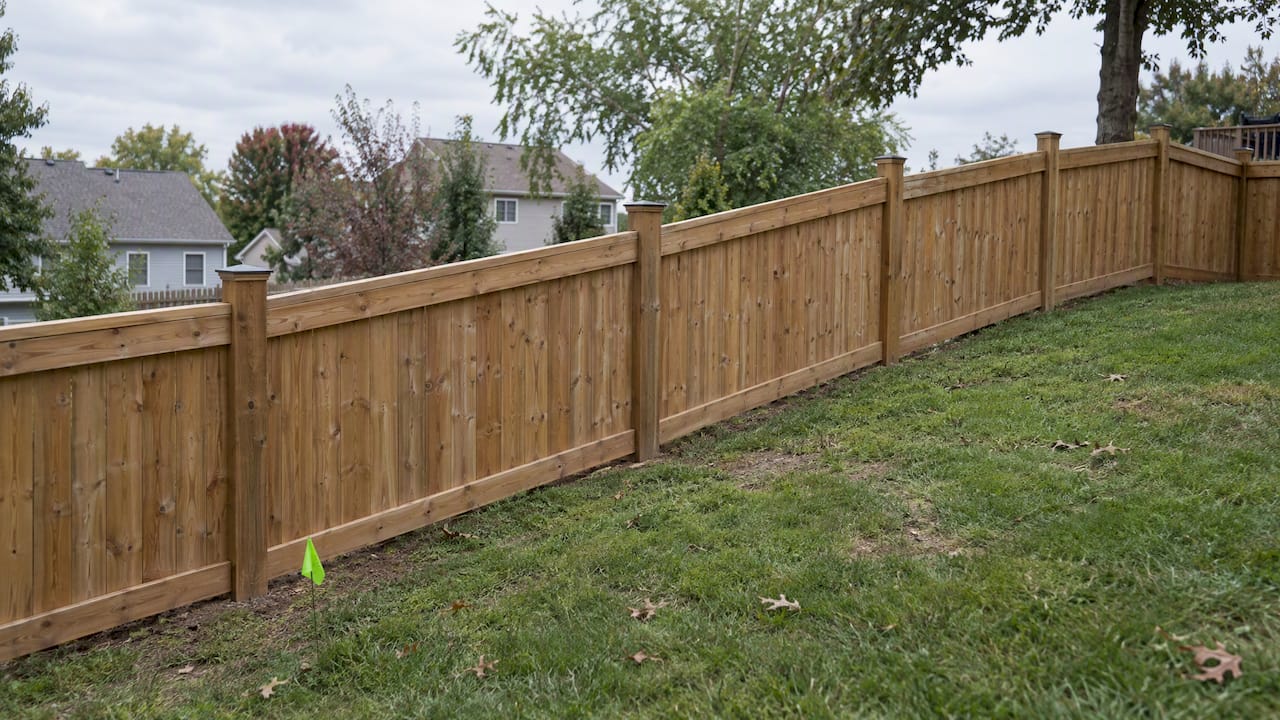
Staining a cedar fence comes down to three decisions: wait until the wood has dried out, choose a penetrating semi-transparent stain instead of paint, and apply a thin coat on a dry, mild day. Do those three things and a stained cedar fence stays good-looking for years. Skip one and you get blotches, peeling or a finish that fails in a season.
We build and care for fences across Wentzville and St. Charles County, so this guide is written for Missouri weather: humid summers, cold snaps and plenty of spring rain.
TL;DR
- Let a new cedar fence dry and weather for several weeks before staining. Wood that is still wet will not take stain evenly.
- Pick a penetrating, semi-transparent stain. The USDA Forest Products Laboratory recommends penetrating finishes over paints and opaque stains for vertical surfaces like fences.
- Clean first, apply thin, back-brush, and work when it is 40°F to 90°F with no rain for at least 24 hours.
- Plan to re-stain when water stops beading on the boards, not by the calendar alone. Semi-transparent finishes usually need a refresh every few years.
- Good construction matters as much as the stain: rust-proof fasteners and boards kept off the soil.
Table of Contents
- Do you need to stain cedar at all?
- When to stain a new cedar fence
- Choosing the right stain
- Prep: where most staining jobs are won or lost
- How to apply the stain
- How often to re-stain a cedar fence
- Common problems and what causes them
- Protecting the fence beyond the stain
- Our perspective on staining cedar fences
- Planning a new fence or a fence upgrade?
- FAQ
- Sources
Do you need to stain cedar at all?
Cedar resists decay on its own, which is why so many people choose it. Left bare, though, it turns silvery gray, checks and cracks along the grain, and weathers unevenly where one side gets more sun or rain than the other.
Staining is a choice about looks and long-term protection. The U.S. Forest Service advises combining methods: naturally decay-resistant heartwood, sound construction that keeps wood off the ground, and a water-repellent preservative with UV-blocking pigment. A stain on its own is not a cure-all, and a stain on a poorly built fence only hides problems for a while.
If you like the weathered gray look, you can skip staining. If you want to keep the warm color or choose a tone, stain it.
When to stain a new cedar fence
New cedar is often damp from the mill, and it also contains natural extractives that can interfere with a finish. Two things decide the timing.
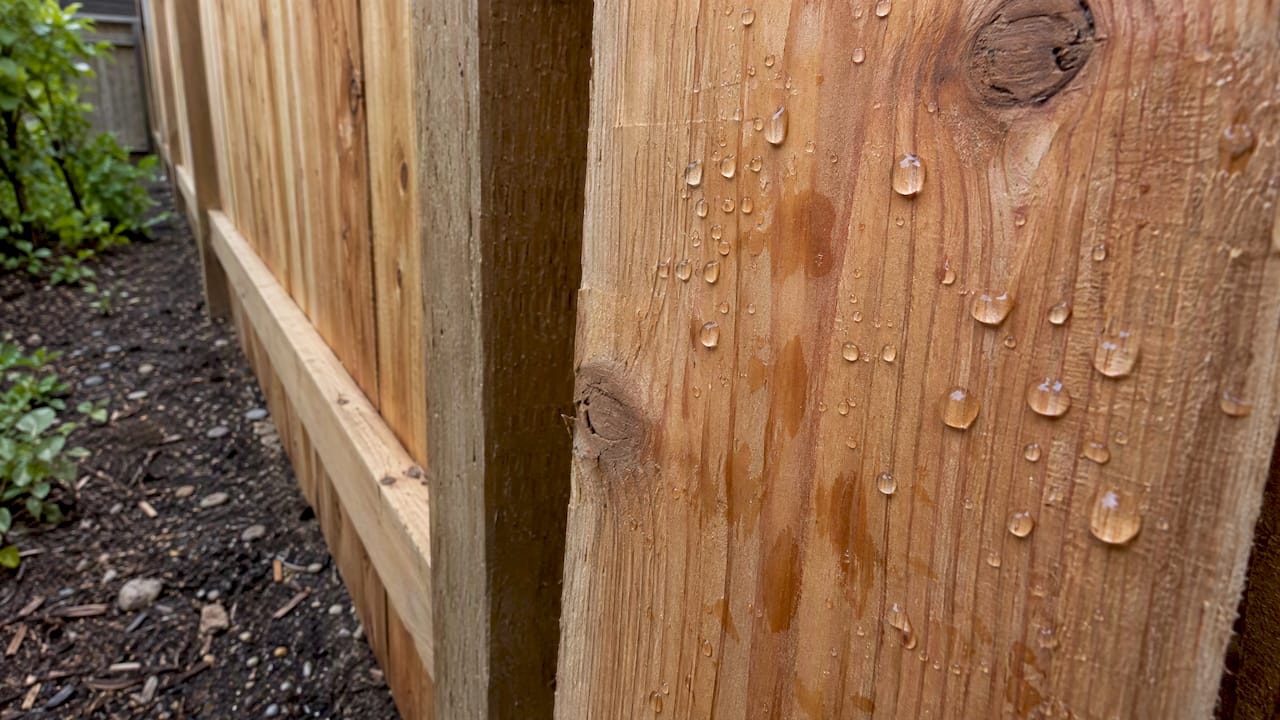
Moisture. The prep guidance we worked from says the wood should reach about 12% moisture content before stain goes on, and that can take weeks. A simple field test: sprinkle water on a board. If it soaks in within a few minutes, the wood is ready. If it beads up, wait longer.
Weather. The Sherwin-Williams fence guide puts the working range at 40°F to 90°F, with no rain in the forecast for at least 24 hours and low humidity. Avoid direct, harsh sun while you work, because stain that dries too fast leaves lap marks.
In our area, that points to two good windows:
| Window | Why it works | Watch for |
|---|---|---|
| Late April to early June | Mild temperatures, boards have dried over winter and early spring | Spring storms, so check the 3-day forecast |
| September to mid-October | Cooler, steadier weather and lower humidity | Early frost, dew on boards in the morning |
Midsummer afternoons in St. Charles County can push boards well past 90°F in direct sun. If you must work then, follow the shade around the fence through the day.
Choosing the right stain
Penetrating semi-transparent stain
For cedar fences, penetrating semi-transparent stains are the standard choice. They let the grain show, block some UV and shed liquid water, and they do not form a thick film that can crack and peel later. This is also the easiest finish to renew, since you clean and recoat instead of stripping.
Paint and solid color
Paint and solid stains give the strongest initial barrier and hide uneven color. The trade-off is that film-forming finishes can trap moisture and eventually peel, as the USDA Forest Products Laboratory notes, and a peeling fence is a lot more work than a fading one. Some solid-color products are made for fences, such as the Behr solid color house and fence stain, so it is a legitimate option when you want a painted look. Just go in knowing the upkeep is different.
If you are weighing stain against paint on other exterior wood too, this homeowner’s guide to exterior wood rot repair explains how moisture damage starts and why protecting wood early matters.
Oil-based or water-based?
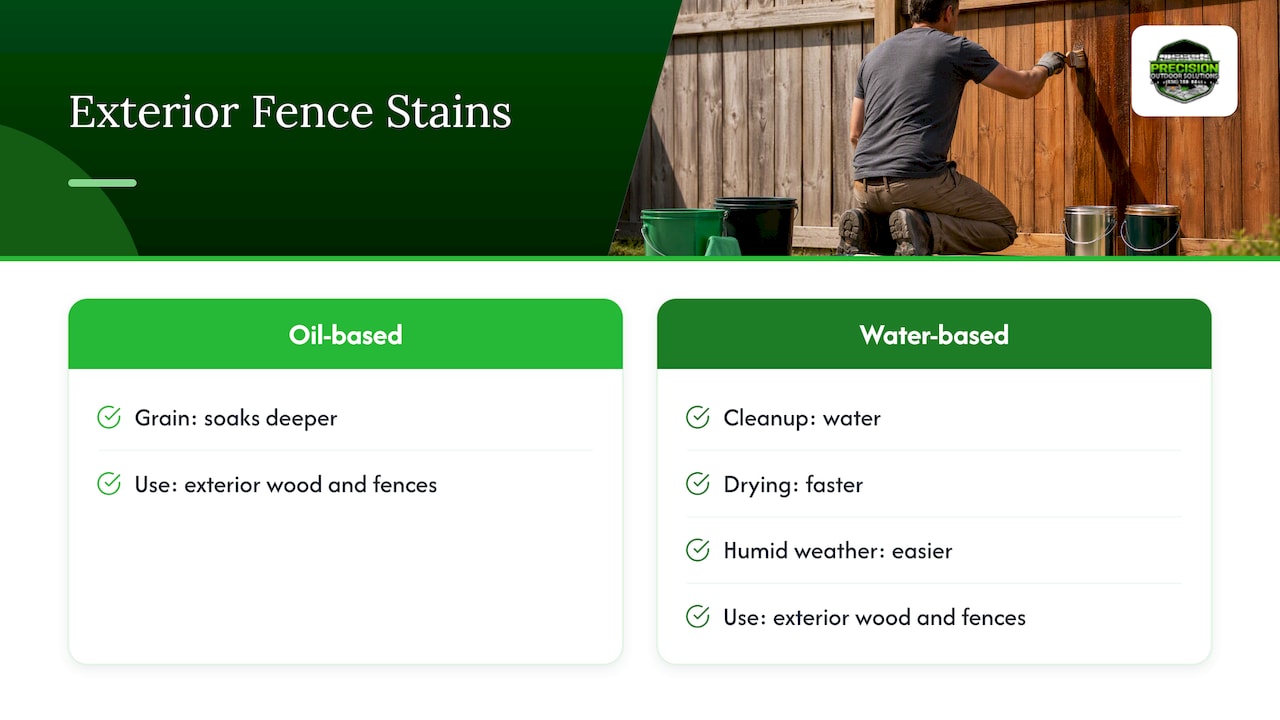
Both work. Oil-based formulas tend to soak deeper into the grain. Water-based formulas clean up with water, dry faster and are easier to work with in humid weather. Whichever you choose, read the label for the application range and recoat time, and use a product made for exterior wood and fences.
A note on cedar’s natural color bleed
Cedar contains water-soluble extractives. They help it resist decay, but they can also bleed through finishes. The National Center for Preservation Technology and Training makes the point that this bleed-through is a characteristic of the wood, not proof the stain is defective. With an opaque finish, it can call for a primer strategy. With transparent finishes, it often mellows with time.
Prep: where most staining jobs are won or lost
Proper prep is the most important step. Olympic’s cedar fence guidance says failing to clean and dry the wood leads to poor adhesion and early failure.
- Walk the fence. Tighten or replace loose pickets, set any popped nails and look for soft spots at the base of posts and boards.
- Check the fasteners. When cedar extractives meet iron or steel and moisture, they react and leave dark stains. Stainless steel, aluminum or good hot-dipped galvanized fasteners avoid that.
- Clean the wood. Remove dirt, mildew and loose fibers with a wood cleaner or deck brightener. Products with sodium percarbonate handle general cleaning, and oxalic acid helps with tannin and iron stains. Oxygen-type bleaches are generally preferred over chlorine bleach, which can damage the wood’s natural color.
- Rinse thoroughly. Leftover cleaner will block stain from penetrating.
- Strip old finish. If the fence has been coated before, the old film has to come off so the new stain can soak in.
- Let it dry. Give the boards time to reach that moisture target before you open the can. Rushing here is the most common mistake we see.
Go easy with a pressure washer. Wide fan tips and a safe distance only, because high pressure raises splinters and furrows the soft cedar surface.
How to apply the stain
You can use a pump sprayer, a roller or a brush. The method matters less than what you do after it.
- Stir, don’t shake. Mix well so pigment is consistent, and combine multiple cans in one bucket so the color does not vary from section to section.
- Test first. Try a hidden spot or a spare picket. Cedar boards can take color differently, and the swatch on the can is only a guide.
- Work in small sections. Stain a few boards at a time, top to bottom, and keep a wet edge so you avoid lap marks.
- Back-brush or back-roll. Even if you spray, work the product into the pores with a brush or roller right away.
- Do not over-apply. More is rarely better. Excess stain sits on the surface instead of soaking in, and later bubbles, peels and cracks.
- Cover the details. Stain board edges, the tops of pickets and the bottom few inches, where water gets in first.
- Dispose of rags safely. Oil-stained rags can heat up and ignite if left crumpled. Lay them flat outdoors to dry, or soak them in water in a metal container, and follow local disposal rules.
After application, drying can take 24 to 48 hours depending on temperature and humidity. Keep sprinklers off the fence in that window. In a lot of St. Charles County yards, a lawn sprinkler can easily hit the fence line, so check where yours aims.
How often to re-stain a cedar fence
There is no single number. How long a finish lasts depends on the product, how many coats went on, and how much sun and rain the fence gets. A south-facing fence with no tree cover will wear out its finish faster than a shaded one. Transparent finishes generally need renewing more often than semi-transparent ones, and solid colors last longer between coats but are harder to redo once they fail.
As a working rule, expect to refresh a semi-transparent finish every few years, and follow the interval printed on your product’s label. Then let the fence tell you:
- Water soaks into the boards instead of beading on the surface.
- The color has faded unevenly, especially at the top and on the sunny side.
- Fine cracks and graying show along the grain.
- Mildew keeps returning after cleaning.
If you see one of these, clean and recoat. Because penetrating stain does not build up a film, a maintenance coat is usually a clean, wash and re-apply job, not a strip-and-start-over one.
Common problems and what causes them
| Problem | Likely cause | Fix |
|---|---|---|
| Blotchy color | Wet wood, uneven absorption, or stain applied in direct sun | Clean, let dry, test on a spare board, recoat in shade |
| Peeling or bubbling | Too much stain, film-forming product, or damp boards | Strip back to bare wood, then reapply thinly |
| Dark streaks below nails | Iron or steel fasteners reacting with cedar extractives | Treat with an oxalic-acid cleaner, switch to stainless or galvanized fasteners |
| Black or green patches | Mildew | Clean with an oxygen-based cleaner before recoating |
| Tacky surface | Excess stain or high humidity | Wait, then wipe or back-brush; avoid heavy coats |
Protecting the fence beyond the stain
Stain is only one layer. The fence’s design and the yard around it do a lot of the work:
- Keep boards off the soil. Ground contact is where rot starts. Leave a gap between the bottom of the pickets and the ground.
- Control water. Downspouts, grading and soggy low spots all keep fence bases wet. If water pools along your fence line, that is a drainage problem worth fixing before you stain.
- Trim back plants. Vines and shrubs hold moisture against the wood and block airflow.
- Set posts properly. A fence that leans or heaves is going to crack its finish regardless. Our advice on post depth covers what to ask a contractor.
- Consider the long game. If you are deciding between wood and a low-maintenance material, this comparison of PVC and composite decking is a useful look at how synthetic materials differ from wood in upkeep, even though it is about decks.
Sloped yards add their own wrinkles, because water runs along the fence line. See our guide to fences on a slope if that describes your lot.
Our perspective on staining cedar fences
We have been building outdoor spaces in Wentzville and across St. Charles County for more than 25 years, and the fences that last share the same traits. The wood was installed on solid posts, water drains away from it, and whoever finished it respected the drying time.
Our honest advice is to treat the stain as the last step in a durable fence, not the first. Before any finish goes on, we look at drainage, post stability and how the fence meets the ground. A fresh coat of stain on a fence with standing water at its base is money wasted.
We also recommend a penetrating, semi-transparent finish for most homeowners. It keeps the cedar looking like cedar, and when it is time for upkeep, you clean and recoat. We think that is the better trade for families who would rather spend their weekends in the yard than scraping.
When you plan a new fence, ask about staining and upkeep at the start, so the style, spacing and materials fit how you want to maintain it.
— Precision Outdoor Solutions
Planning a new fence or a fence upgrade?
If your cedar fence is worn beyond a recoat, or you are starting from scratch, Precision Outdoor Solutions can help with fence installation in Wentzville and St. Charles County. We handle site consultation, design planning, material selection and installation, with clear timelines and updates along the way. Not sure which style suits your lot? Start with our look at fence styles that boost curb appeal, then get in touch for a free estimate.
FAQ
How long should I wait to stain a new cedar fence?
Wait until the boards have dried out, which can take several weeks. The wood should be near 12% moisture content. A quick check is to sprinkle water on a board: if it soaks in, the wood is ready, and if it beads, wait longer.
What is the best stain for a cedar fence?
For most homeowners, a penetrating semi-transparent stain. It shows the grain, blocks UV and sheds water without forming a film that can peel. Choose a product made for exterior wood, and test it on a spare board first.
How often should a cedar fence be stained?
It depends on the product and the exposure, but semi-transparent finishes typically need a refresh every few years. Watch for water soaking in instead of beading, fading and fine cracks, and follow the interval on your product label.
Can I stain a cedar fence in the rain or cold?
No. Aim for 40°F to 90°F and no rain for at least 24 hours after you finish. Cool, damp boards will not absorb the stain or dry properly, and a rain shower soon after application can ruin the finish.
Do I need to clean the fence before staining?
Yes. Dirt, mildew and loose fibers stop stain from soaking in, which leads to poor adhesion and early failure. Use a wood cleaner or brightener, rinse well and let the fence dry fully.
Sources
- Water Repellents and Water-Repellent Preservatives for Wood, USDA Forest Products Laboratory
- How to Stain a Wood Fence, Sherwin-Williams
- How to Stain a Cedar Fence, Olympic
- Treatments to minimize extractives stain in Western red cedar, BioResources
- Understanding Traditional and Modern Paints and Stains for Exterior Wood, NCPTT
- U.S. Forest Service Research, wood protection guidance
- Solid Color House & Fence Wood Stain, Behr Pro
Recommended
- Fence On A Slope: Homeowners Match Panels To 12–15° Grades
- Pick The Right Fence For Your Slope: Rack Up To 12–15° For Homeowners
- Which Fence Styles Actually Boost Curb Appeal?
This article was prepared with AI assistance for general information. For recommendations specific to your property, contact Precision Outdoor Solutions. Call or text us at (636) 358-8644.