Permeable pavers let rain and melting snow pass through the surface and soak into an aggregate base underneath, instead of running off toward the street. The main benefits are less runoff, cleaner water, fewer puddles on your patio or driveway, and less need for bulky drainage structures. They also come with real upkeep and installation requirements, and we cover both below.
We are Precision Outdoor Solutions, a landscaping and hardscape company serving Wentzville and St. Charles County. Drainage is a big part of our daily work, so this guide is written from the homeowner’s side of the fence.
TL;DR
- Permeable pavers reduce runoff by letting water infiltrate through joints into a stone base, where it is stored and slowly released into the ground.
- The base layers matter as much as the pavers. A thin or poorly built base is where most problems start.
- They need upkeep. Keep sediment and winter sand out of the joints, and test drainage once a year.
- They work best on patios, driveways and walkways where water pooling is a problem.
- Ask a local contractor to check your soil and slope before you commit.
Table of Contents
- How permeable pavers work
- The main benefits of permeable pavers
- The downsides to weigh
- Are permeable pavers cheaper than concrete?
- Maintenance: what keeps permeable pavers working
- Where permeable pavers make the most sense
- Why the base matters more than the paver
- Our perspective
- Plan your project with Precision Outdoor Solutions
- FAQ
- Sources
How permeable pavers work
A standard paver patio sheds water sideways, usually toward a lawn, a gutter or a storm drain. A permeable system is built differently. The surface is made of concrete pavers with joints or openings that let water flow down into an open-graded stone base, which the Federal Highway Administration describes as a reservoir. Water collects in that stone layer and then moves into the soil below, or out through a drain if the soil is slow.
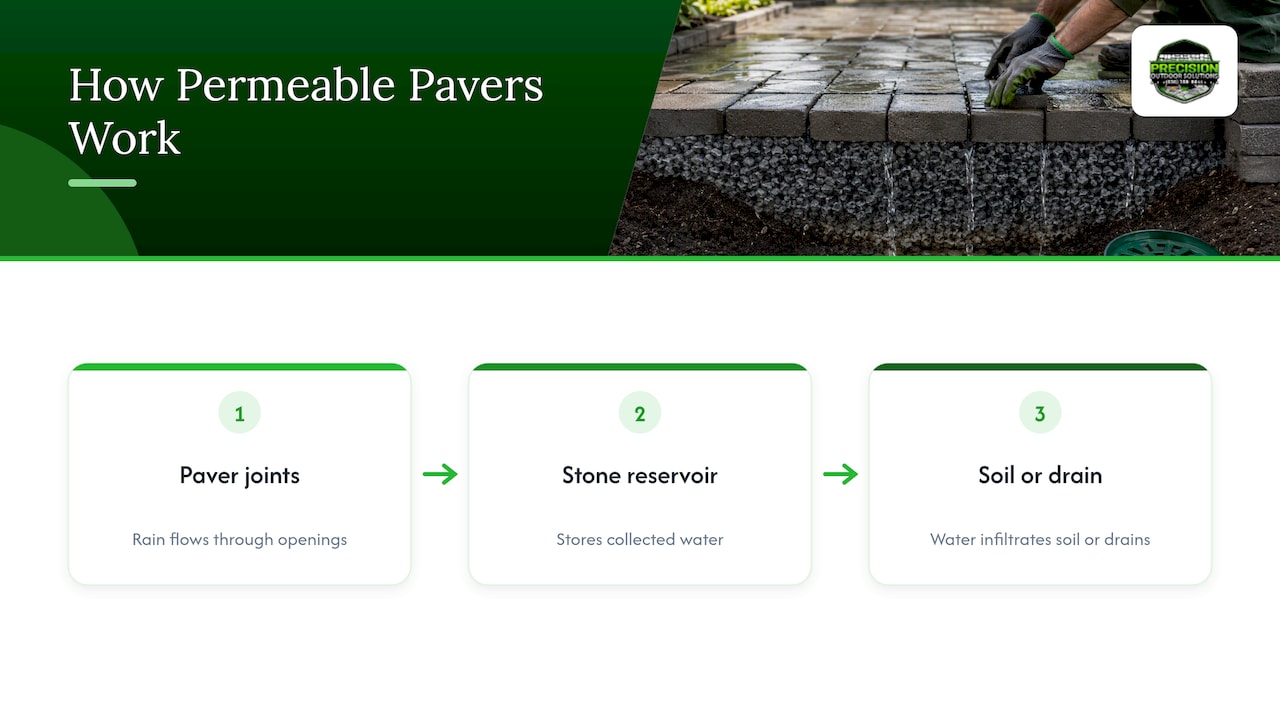
That is why the part you cannot see decides how well the system performs. The FHWA’s guidance on permeable pavement use points to the design of the underlying aggregate layers as central to both strength and stormwater capacity.
The same idea is behind the EPA’s overview of permeable pavement. It lists interlocking pavers among the options, alongside pervious asphalt and pervious concrete, as alternatives that reduce runoff by infiltrating rain and melting snow.
The main benefits of permeable pavers
Less runoff, less pooling
This is the benefit most homeowners care about. Rain that soaks through the surface is not sitting on your patio, and it is not rushing toward a neighbor’s yard. The EPA’s stormwater fact sheet on permeable pavements describes them as a stormwater control that lets water infiltrate through the surface to the ground below.
If you already deal with a soggy corner near the house, a permeable surface can be one part of the fix. It is rarely the whole fix. Grading still matters, and we cover that in our guides on patio drainage design and stopping water pooling on a patio.
Cleaner water leaving your property
Permeable systems do more than move water. The stone base and the joint material help hold back sediment and some pollutants. A USGS study, which tested three permeable pavement types side by side, looked at how each performed on water quality and infiltration under heavy sediment loads. The EPA also notes that permeable pavements can help filter out pollutants that contribute to water pollution.
For a family in St. Charles County, that means less of what lands on your driveway, such as oil drips and dirt, ends up in local creeks.
Less need for big drainage structures
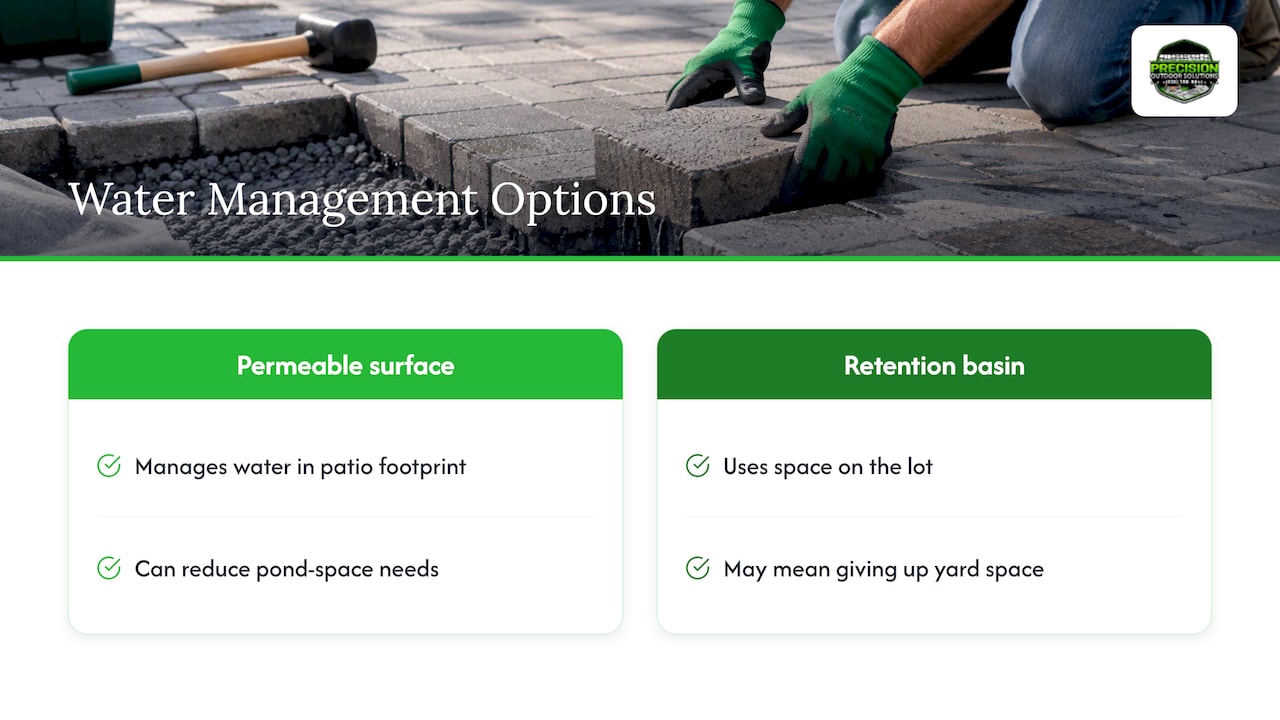
Because the base stores water, a permeable surface can reduce the need for space-hungry drainage features like retention ponds. The EPA’s research on low impact development says these practices often have lower life-cycle costs than traditional “grey” infrastructure, though it also acknowledges maintenance concerns in some cases. For a residential lot, the practical version is simpler: you may be able to manage water in the footprint of your driveway or patio rather than giving up yard space to a basin.
If your problem is a wider roof and gutter issue, it helps to look at the whole picture. This guide to drainage improvements and alternatives from a St. Louis area exterior company is a useful companion read on the roofing side.
Safer surfaces in winter
Meltwater that drains into the base is not sitting on top to refreeze. A cold-climate overview from Earth911 says research shows permeable pavements freeze more slowly and thaw more quickly than conventional pavement, which can reduce the need for de-icer. Missouri winters swing around freezing often, so this is relevant here.
There is a catch we explain in the maintenance section: do not use sand for traction.
Repairs are easier
Pavers are individual units. If a section settles or gets stained, a contractor can lift and reset just that area. A poured slab that cracks usually means cutting out and replacing a larger piece. That is a general feature of segmental paving, and it applies here too.
A good look
Permeable pavers come in many shapes and colors, so you do not give up curb appeal for performance. In our design work, we treat appearance and drainage as one plan, which is the idea behind our landscape design process.
The downsides to weigh
Honest advice includes the drawbacks. Here are the ones we raise with homeowners.
- Maintenance is part of the deal. The EPA says planning for upkeep is a critical part of green infrastructure. Permeable pavers are not a install-and-forget surface.
- The base is deeper and more involved. More excavation and stone means more labor than a basic patio base. For a look at what a solid conventional base involves, see our patio base preparation guide.
- Soil matters. Slow-draining clay can limit how quickly water leaves the base. Our region has plenty of clay, so a soil check is a sensible first step.
- Sediment is the enemy. Soil washing from garden beds onto the surface will clog joints over time.
- It is not a cure-all. Serious yard flooding, a wet basement or a slope problem usually needs grading or a drain system in addition to any paver choice.
Are permeable pavers cheaper than concrete?
Usually not up front. The extra excavation and stone base typically raise the installed price compared with a plain slab. Over time the picture can change, because you may avoid separate drainage work, and the EPA’s low impact development findings point toward lower life-cycle costs in many cases. We do not publish set prices, because the cost depends on size, soil, access and the drainage fixes needed. We give a free estimate after walking your property.
If you want to compare with a standard slab, our concrete services page explains what we build in that category.
Maintenance: what keeps permeable pavers working
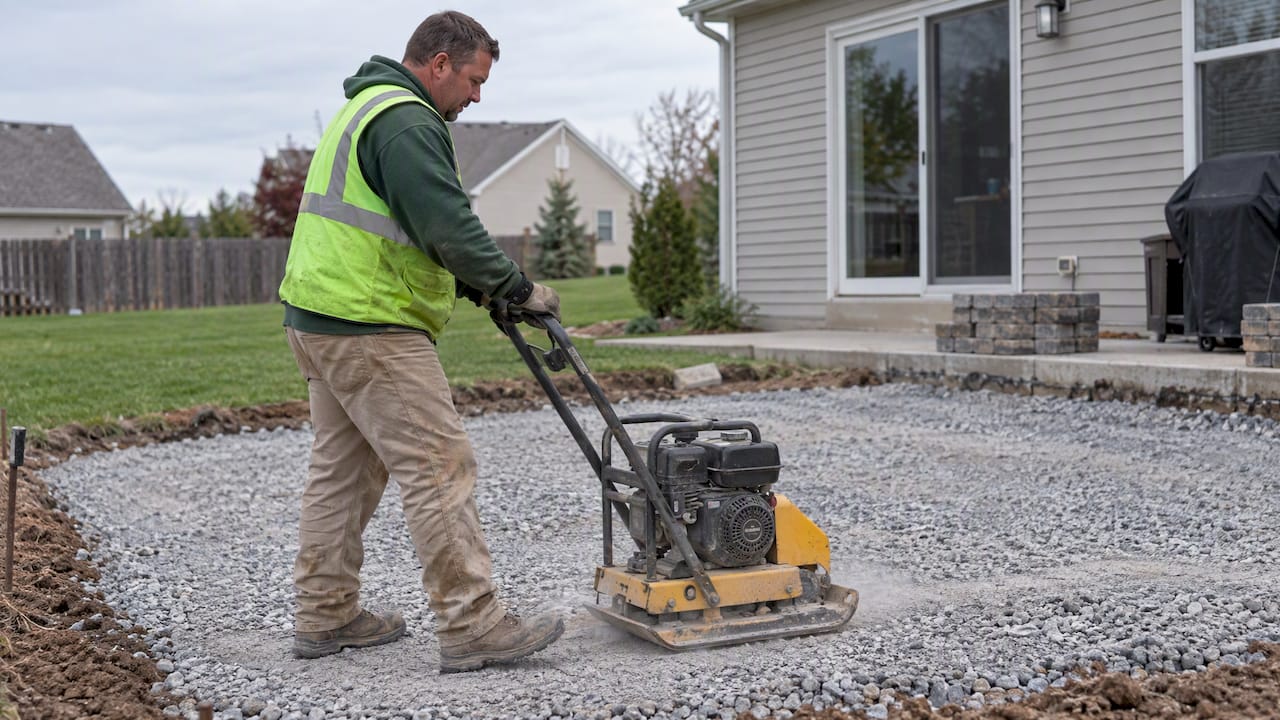
The surface only drains if the voids stay open. The FHWA’s maintenance guidance recommends routine upkeep, ideally vacuum sweeping with regenerative air equipment about twice a year, to prevent clogging.
A simple yearly water test
During a dry spell, run a hose over the surface or pour water on it. If water ponds or takes a long time to disappear, the joints may be starting to clog. The FHWA brief describes infiltration testing as a way to monitor performance. Catching this early is much cheaper than fixing a clogged base later. Call a pro if you see ponding.
What to avoid
- Sand for winter traction. Sand fills the joints and can clog the system permanently. If you need traction on ice, ask your installer which grit or product suits your pavers.
- Pressure washing as a fix. Pushing debris down with a blast of water can drive it deeper into the stone. Ask for vacuum-based cleaning instead.
- Soil washing in from beds. Mulch, soil and lawn clippings should stay off the surface. The EPA’s maintenance guidance highlights managing the landscaping around green infrastructure, since sediment from nearby areas can cause problems.
- Sealing without a plan. Sealers and polymeric sand are common on regular pavers, but they can affect how a surface drains. Check with your installer first. Our guide to sealing pavers explains timing for standard installations.
Where permeable pavers make the most sense
| Situation | Good fit? | Why |
|---|---|---|
| Patio that floods after storms | Often | Water goes into the base instead of pooling |
| Driveway with runoff toward the street | Often | Reduces water leaving the lot |
| Walkway next to a garden bed | Maybe | Needs edging so soil does not wash in |
| Steep slope or foundation leaks | Not alone | Grading or a drain system comes first |
| Area where you plan heavy sand use in winter | No | Sand clogs the joints |
If the water issue is on a slope, read our guide on slope erosion control. If it is the driveway, see our driveway drainage ideas.
Why the base matters more than the paver
We tell homeowners this early: the visible pavers are the smaller part of the job. The stone reservoir below is what gives the system its strength and its water capacity. A deeper explanation of how layered aggregate and detention work under a surface is in this homeowner guide to under-deck drainage, which shows the same logic of managing water below the finished surface.
That is why we ask about soil, slope and where water currently goes before we talk about product. A good plan covers the base depth, an outlet for overflow, edge restraint and the grading around the site.
Our perspective
We have spent over 25 years building patios, retaining walls and drainage fixes in Wentzville and St. Charles County. What we see most often is that homeowners start with a surface question and end up with a water question. They want a nicer patio, but the real issue is where the rain goes.
So we start with drainage. If a permeable system fits your yard, we will say so and explain what upkeep it needs. If grading, a drain line or a standard paver patio with proper slope is the better answer, we will say that too. Durability comes from the build under the surface, clear timelines and a site that is kept clean and professional while we work.
We also think maintenance should be said out loud before the contract is signed. A surface that needs a yearly check is fine when you know about it. It is frustrating when you do not.
— Precision Outdoor Solutions
Plan your project with Precision Outdoor Solutions
If you are thinking about a patio, walkway or driveway area that needs to handle water better, we can walk the property with you, look at the slope and soil, and talk through options. Start with our hardscape and patio installation service or our yard drainage solutions. Not sure who to hire? Our checklist on choosing a hardscape contractor lists what to ask any bidder.
FAQ
What are the downsides of permeable pavers?
They need regular upkeep, a deeper and more detailed base, and soil that suits the design. Sediment and winter sand can clog the joints if they are not managed. They also may cost more to install than a basic slab.
What goes under permeable pavers?
An open-graded stone base, often in several layers, that stores water and supports the load. The FHWA describes this base as a reservoir that lets water drain freely. The exact depth depends on your soil, the traffic and the water you need to hold, so ask your installer for the design.
Are permeable pavers worth it?
They can be, especially where water pooling or runoff is a problem and you are willing to do light yearly upkeep. They are less useful if the real issue is a steep slope or foundation drainage that needs other fixes. A site visit is the best way to decide.
Is permeable pavement cheaper than concrete?
Usually it costs more at installation, because of the extra excavation and stone. Savings can come later if it replaces separate drainage work. The EPA notes that low impact development often has lower life-cycle costs than traditional drainage, but your own numbers depend on the site.
How do I know if my permeable pavers are clogged?
Water ponds on the surface or drains slowly during a dry spell. Pour water on the pavers once a year to check. If it lingers, have a professional vacuum the joints rather than pressure washing them.
Sources
- FHWA TechBrief: Permeable Concrete Pavements
- FHWA Tech Brief: Use of Permeable Pavements
- EPA: Soak Up the Rain, Permeable Pavement
- EPA: Stormwater Best Management Practice, Permeable Pavements
- EPA: Maintenance of Low Impact Development
- EPA: Green Infrastructure Installation, Operation, and Maintenance
- USGS: Performance of three types of permeable pavement under high sediment loading
- Earth911: Sustainable Pavers for Cold Climates
Recommended
- Seal Pavers Right: Wait A Month After Polymeric Sand For Homeowners
- 25–50 Years: How Homeowners Build Paver Patios That Last
- DIY Patio Base Preparation: Pro Checks For A 4 To 6 Inch Base
- Patio Drainage Solutions That Actually Stop Water Pooling
This article was prepared with AI assistance for general information. For recommendations specific to your property, contact Precision Outdoor Solutions. Call or text us at (636) 358-8644.