Most Missouri homeowners should plan on roughly $20 to $60 per square foot of wall face for an installed retaining wall. That figure is a statewide range from a cost guide, and it covers materials, labor and the base. Your number lands higher or lower depending on wall height, material, access to the site and, most of all, how well the wall is drained.
Below you’ll find the math behind that range, sample costs for 20-, 40- and 100-foot walls, what changes a quote, and when St. Charles County asks for a permit.
TL;DR
- Plan on $20 to $60 per square foot of wall face, installed. Multiply length by height to get your square footage.
- Material matters: timber is usually the cheapest and poured concrete the most expensive, with segmental block and natural stone in between.
- Drainage is not an optional extra. A wall without drain stone, pipe and fabric behind it is the one that fails.
- In St. Charles County, walls 4 feet or lower (measured from the bottom of the footing) are generally exempt from a building permit. Taller walls need a closer look and often engineering.
- Compare quotes line by line, not by bottom-line total.
Table of Contents
- How retaining wall pricing works
- Retaining wall cost by material
- What a 20, 40 or 100 foot wall costs
- What raises or lowers your estimate
- Permits and engineering in St. Charles County
- Our perspective: where the money should go
- DIY or hire a pro?
- How to compare retaining wall quotes
- Does a retaining wall add value?
- Get a firm number for your yard
- FAQ
- Sources
How retaining wall pricing works
Contractors price retaining walls by the square foot of wall face. That means the length of the wall times its height. A wall 30 feet long and 3 feet tall has 90 square feet of face.
The per-square-foot price bundles several things:
- Excavation and a compacted base
- The wall material itself
- Drainage stone, perforated pipe and filter fabric
- Backfill and compaction in layers
- Labor, equipment and haul-off of excess soil
A statewide guide puts Missouri at $20 to $60 per square foot, and local cost pages for St. Louis and Kansas City sit inside similar ranges. Treat any single figure as a starting point. A site that a skid steer can reach from the street costs less than a backyard where every block gets carried through a gate.
Retaining wall cost by material
Material choice moves the price more than most homeowners expect. One 2026 cost calculator breaks installed prices down like this:
| Material | Installed cost per sq ft | Typical fit |
|---|---|---|
| Timber | $15 to $25 | Low, short-term or budget walls |
| Segmental block | $20 to $40 | Most residential yards, curves, tiered walls |
| Natural stone | $25 to $50 | Visible front-yard walls, a custom look |
| Poured concrete | $30 to $60 | Tall walls, tight spaces, engineered designs |
Here is how we think about each one for homes in Wentzville, St. Peters, O’Fallon and Troy.
Segmental block
Interlocking block is the workhorse for residential yards. It handles gentle curves, comes in many colors, and tolerates small movement in clay soils better than a rigid wall. If you’re weighing options above 4 feet, our guide to retaining wall blocks that work over 4 feet goes deeper.
Natural stone
Stone costs more because it takes more skill and time to fit. It’s a good choice where the wall is part of the front landscape and you want it to look like it was always there.
Poured concrete
Poured walls cost more per square foot, but they are the answer when the wall is tall or the space is too tight for a block wall’s footprint. They are usually engineered. We cover related work on our concrete services page.
Timber
Timber is the lowest upfront cost and the shortest-lived. In Missouri’s wet springs and freeze-thaw cycles, wood in contact with soil breaks down. It can make sense for a small garden bed edge, less so for a wall holding up a slope near your house.
What a 20, 40 or 100 foot wall costs
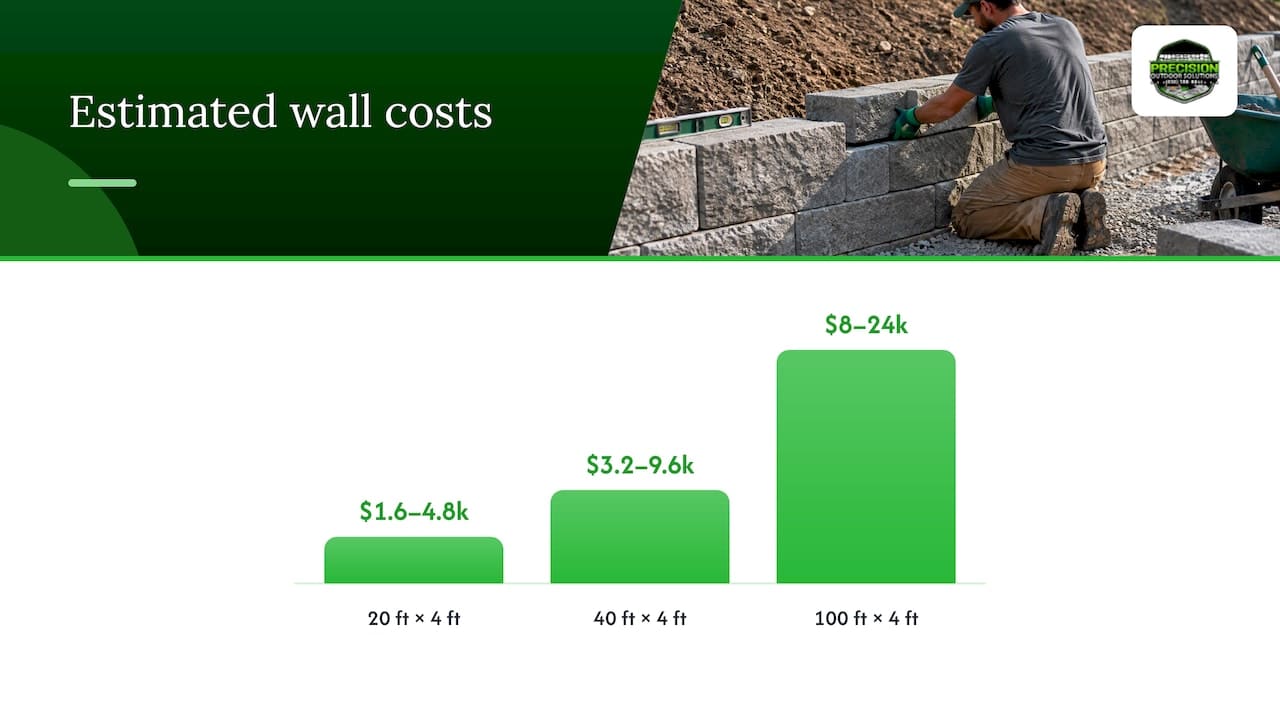
People search for these lengths because they know how long the wall needs to be. Height is the other half of the equation. The figures below are straight arithmetic: length times height times the $20 to $60 per square foot range. They are planning numbers, not quotes.
| Wall length | Height | Face area | Estimated range |
|---|---|---|---|
| 20 ft | 3 ft | 60 sq ft | $1,200 to $3,600 |
| 20 ft | 4 ft | 80 sq ft | $1,600 to $4,800 |
| 40 ft | 3 ft | 120 sq ft | $2,400 to $7,200 |
| 40 ft | 4 ft | 160 sq ft | $3,200 to $9,600 |
| 100 ft | 3 ft | 300 sq ft | $6,000 to $18,000 |
| 100 ft | 4 ft | 400 sq ft | $8,000 to $24,000 |
A few things to notice. The range is wide because material and access are wide. A 4-foot wall costs a third more than a 3-foot wall of the same length, but the real cost of height is bigger than the area suggests: taller walls need deeper bases, more drainage stone, and sometimes geogrid reinforcement. And a 100-foot wall rarely costs exactly five times a 20-foot one, since setup, equipment and mobilization are spread over more footage.
Once you know the length and height, a site visit turns this range into a firm number.
What raises or lowers your estimate
Height
Height is the biggest driver. Past about 4 feet, the wall has to resist much more soil pressure, so the design changes. Our article on retaining wall height rules walks through the checklist.
Access
Can equipment reach the wall line? If materials must be moved by wheelbarrow, labor hours go up. Fences, trees, a finished patio or a septic field nearby all add complexity.
Soil and slope
Much of St. Charles County sits on clay-heavy soil that holds water and swells when wet. That pushes pressure on the wall. A steep grade behind the wall, or a driveway or structure above it, adds load. If your project is a slope, see our planning guide for retaining walls on slopes.
Drainage
Drainage is the factor that decides whether a wall lasts. The essentials are drainage aggregate, a perforated pipe at the base and filter fabric. Cheap quotes often leave these out or thin them. You don’t see the difference on day one. You see it three springs later as a bulge or a lean. Our retaining wall drainage guide explains what should be behind your wall, and if water is already a problem in your yard, our yard drainage solutions work often comes first.
Engineering and permits
Engineered drawings add a fee, but they also reduce the risk of a failure that costs far more. More on that next.
Removal and extras
Tearing out an old failing wall, hauling away soil, adding steps, lighting, a cap or a guard fence on top all show up as extra lines.
Permits and engineering in St. Charles County
In St. Charles County’s building code, permits are not required for retaining walls not over 4 feet high, measured from the bottom of the footing to the top of the wall. The exemption does not apply if the wall supports a surcharge (such as a driveway or building above it) or impounds certain liquids.
Two practical points:
- The 4 feet includes the buried footing, so a wall that shows 3.5 feet above grade may already be over the line.
- Other cities and counties set their own rules. Some areas use a lower threshold, and walls over 4 feet typically need engineered plans. Check with your city or county building department before you sign anything.
If you’re unsure whether your wall needs an engineer, read our article on when you need an engineered retaining wall. Then confirm with the building department for your address.
Our perspective: where the money should go
After more than 25 years building outdoor spaces in Wentzville and across St. Charles County, we see the same pattern. Homeowners shop on the per-square-foot price, and the wall that fails is almost always the one where the money was saved below grade, where nobody was looking.
So we put the budget where it counts: a properly dug and compacted base, drainage that moves water out from behind the wall, and a design that fits your actual slope and soil. We’d rather give you a clear scope and timeline, with updates as the job moves along, than a low number that grows with change orders.
We also like to look at drainage before we talk about walls. Sometimes a regraded yard or a drain line solves the problem for less. When a wall is the right answer, we say so and explain why.
— Precision Outdoor Solutions
DIY or hire a pro?
A short garden wall under about 2 feet is a reasonable weekend project for a capable homeowner. Beyond that, the risks rise quickly:
- Base and compaction mistakes are hidden until the wall moves.
- Drainage shortcuts are easy to take and expensive to fix.
- Permit and utility issues: call 811 before you dig, and check the 4-foot rule above.
- Tools and haul-off: renting a plate compactor and moving tons of block and stone adds cost and effort.
- No warranty: if it leans, the repair is yours to pay for.
DIY saves labor, which is a large share of the installed price, but it only saves money when the wall is small and done right. If a wall is already leaning or cracking, see our guide to fixing a failing retaining wall before you spend on a rebuild.
How to compare retaining wall quotes
Two quotes for the “same” wall can differ by thousands. Ask each contractor to put these in writing:
- Wall length, height and total face area
- Material, brand and color of the block or stone
- Base depth and material, and how it will be compacted
- Drainage: stone depth, pipe, fabric and where the pipe outlets
- Whether engineering and permits are included
- Removal of old material and excess soil
- Start and finish timeline, and how you’ll get updates
- Warranty terms
If you’re also pricing other work, a St. Louis remodel cost and bid checklist shows how to read bids and permit steps, and the same habits apply to outdoor projects. Our own list of questions to ask a landscaper is a good companion.
Does a retaining wall add value?
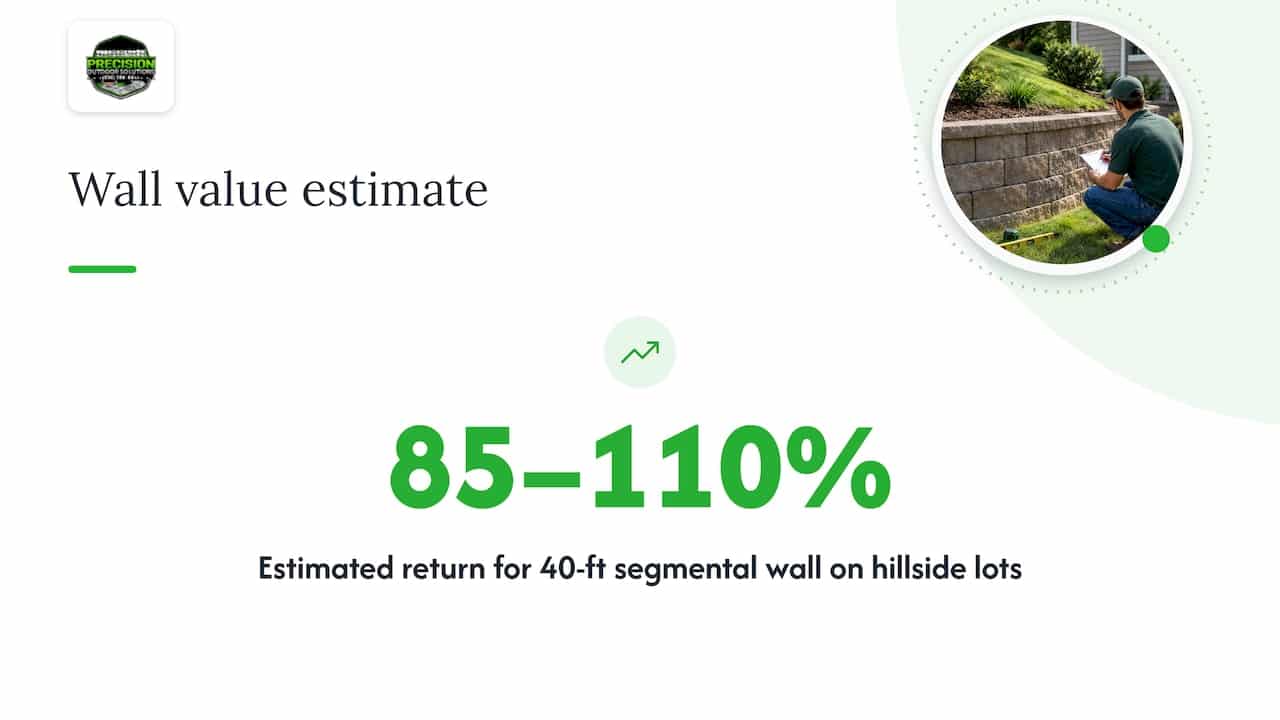
It can, mainly by turning unusable slope into flat yard space and by controlling erosion. One aggregator estimate says a 40-foot segmental wall returns 85 to 110 percent of its cost on hillside lots. Treat that as a rough guide, not a promise. The value is most real when the wall solves a problem a buyer can see: a usable backyard, a dry basement, a driveway that no longer washes out. For more on that, read why retaining walls are a smart investment for St. Charles County property.
Get a firm number for your yard
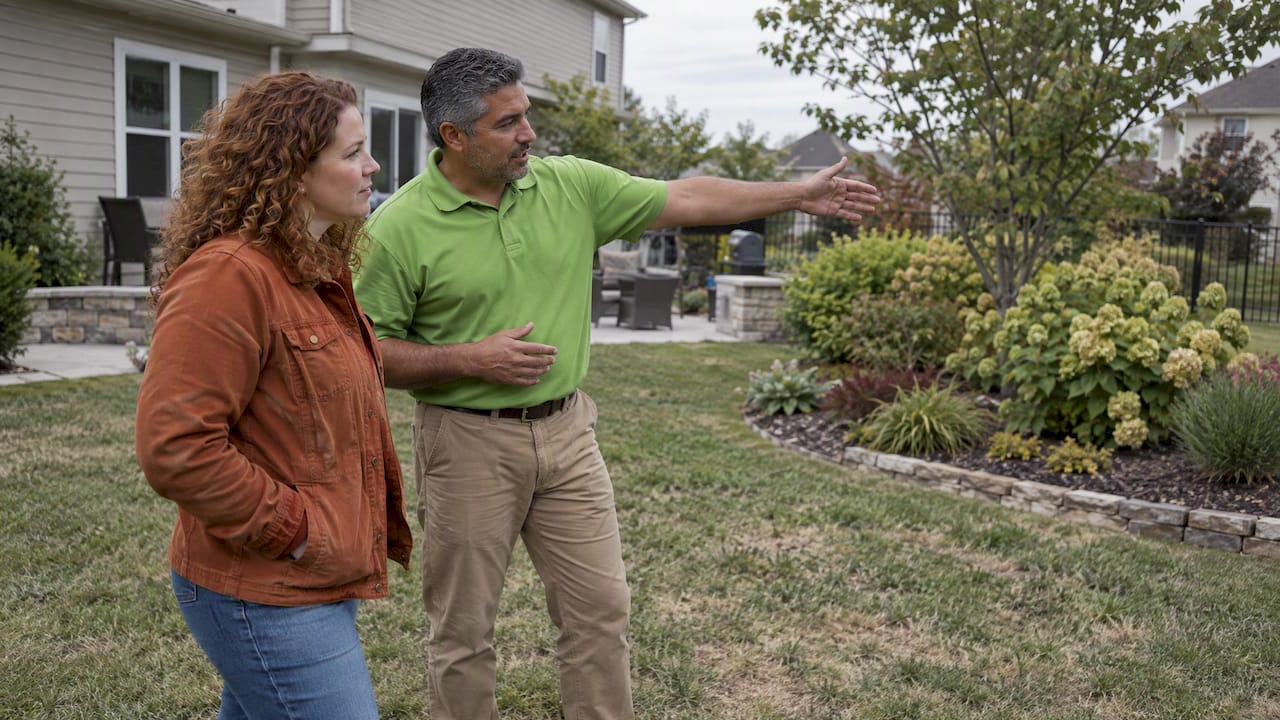
A range gets you started. A site visit gets you a price. Precision Outdoor Solutions designs and builds retaining walls, patios, drainage and fencing for homeowners in Wentzville, St. Peters, O’Fallon, Troy and the rest of St. Charles County. We walk the site, check drainage and slope, talk through materials, and give you a written scope. Start with our hardscape and patio installation page or our landscape design service and ask for a free estimate.
FAQ
How much does a 100 foot retaining wall cost in Missouri?
At the $20 to $60 per square foot range, a 100-foot wall that is 3 feet tall (300 square feet) would run about $6,000 to $18,000. At 4 feet tall it would be about $8,000 to $24,000. Material, access and drainage decide where you fall in that range.
What is the 1/3 rule for retaining walls?
It is a common rule of thumb that the buried part of the wall, the base, should be about one third of the wall’s exposed height for gravity-style block walls. Actual embedment depends on the design, soil and any geogrid. A contractor or engineer should set it for your site.
Do I need a permit for a retaining wall in St. Charles County?
Walls not over 4 feet high, measured from the bottom of the footing, are generally exempt under the county building code, unless they support a surcharge. Taller walls need a permit review. Confirm with the building department before work starts.
What is the cheapest material for a retaining wall?
Timber usually has the lowest upfront price, but it also has the shortest lifespan in wet Missouri soil. Segmental block often gives the best balance of cost and durability for homes.
Sources
- Retaining Wall Cost in Missouri (2026), ClearCost
- Retaining Wall Cost Calculator, estimation by material (2026)
- Article II: Building Code, St. Charles County, MO
- How professional landscaping boosts your home value in 2026
- St. Louis Remodel Costs, Permits, and Bid Checklist
Recommended
- Retaining Wall Cost: How Much To Budget For Your Yard
- Fix A Failing Retaining Wall: Homeowner’s Repair Guide
- Retaining Wall Drainage: A Practical Homeowner’s Guide
- Retaining Walls For Slopes: Your Complete Planning Guide
This article was prepared with AI assistance for general information. For recommendations specific to your property, contact Precision Outdoor Solutions. Call or text us at (636) 358-8644.